
Liquid Cargo and Ballast Handling on Chemical Tankers
- Format: online and offline
- Language: Ukrainian, Russian, English
- Price: 4000₴
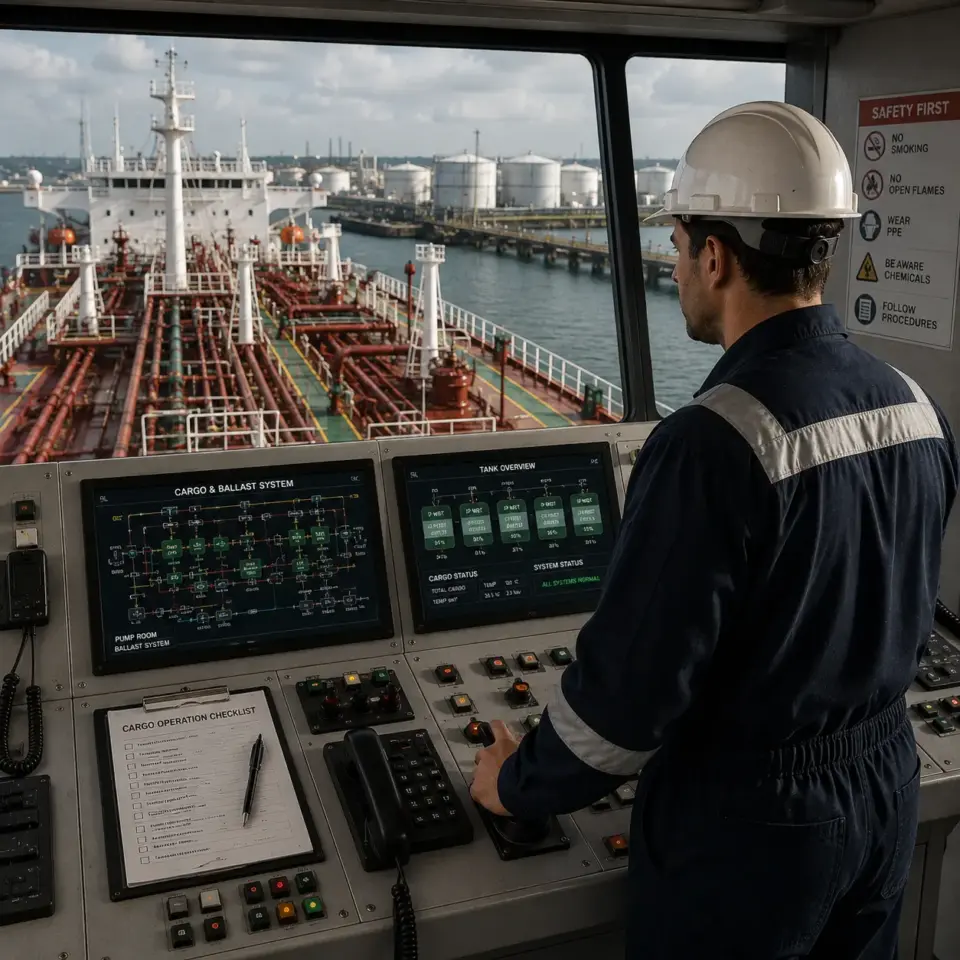
Liquid Cargo and Ballast Handling on Chemical Tankers is a specialized practical training course designed for deck officers and personnel responsible for cargo and ballast operations on board chemical tankers using a cargo handling simulator.
The simulator part of the basic and advanced training is conducted in accordance with IMO Model Course 1.37, 2026 edition, Chemical Tanker Cargo and Ballast Handling Simulator. This model course is a supplementary component of Model Courses 1.01 and 1.03 and covers those elements of the competences in STCW Code tables A-V/1-1-1 and A-V/1-1-3 that can be trained and assessed on a chemical tanker cargo and ballast handling simulator. The training follows STCW Convention regulation V/1-1, paragraphs 1, 2, 5 and 6, STCW Code section A-V/1-1, paragraphs 1 and 2, STCW Code section A-I/12 and STCW Code section B-I/12, paragraph 71.
During the training, participants perform the complete cargo handling cycle on a chemical tanker, including cargo tank preparation, cargo loading and discharge, ballast operations, cargo monitoring, operation of cargo pumps and piping systems, stability control and emergency response using realistic simulator scenarios.
- plan and conduct cargo and ballast operations on chemical tankers safely and efficiently;
- operate cargo pumps, pipelines, valves and auxiliary cargo systems;
- monitor cargo tank levels, pressure, temperature and cargo condition throughout cargo operations;
- carry out ballasting and deballasting operations in accordance with operational procedures;
- maintain vessel stability, trim and hull stress within safe operating limits;
- operate cargo monitoring, alarm and emergency shutdown (ESD) systems;
- apply safe working practices when handling hazardous liquid chemical cargoes;
- respond effectively to equipment failures, cargo leaks and emergency situations;
- communicate effectively with shipboard personnel during cargo operations;
- follow established safety procedures to ensure the protection of personnel, the vessel and the marine environment.
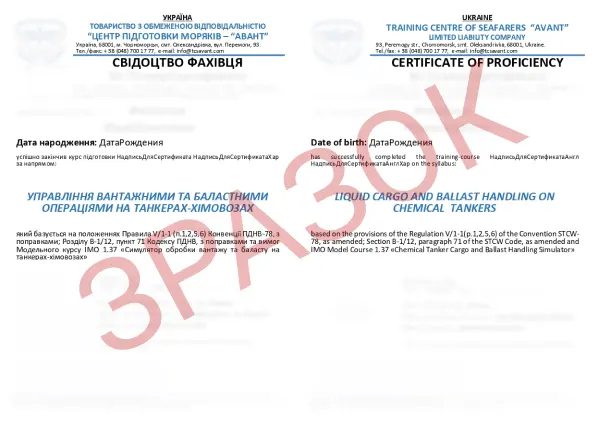
Successful completion of the course, confirmed by passing the final test (and, where applicable, demonstrating practical competence), entitles the participant to receive a certificate of completion for the Liquid Cargo and Ballast Handling on Chemical Tankers course.
The training is conducted in accordance with STCW Regulation V/1-1, STCW Code Section A-V/1-1, IMO Model Course 1.37, and the training centre's approved training programme.
How it works:
1. Choose us
We have been in the market for over 20 years. Our courses are certified and recognized worldwide.
2. Register
Complete online registration to save time. Choose a course and after registration and payment, you will get access to training without extra steps.
3. Complete the course
Training is available from any device: PC, laptop, tablet or smartphone (iOS/Android). You can choose online format or download materials.
4. Evaluate knowledge
Assessment is conducted in the form of a test with multiple choice questions. After successful completion of testing, you will receive a certificate.
5. Get certificate
The manager will email you the completed certificates. You can print the certificate at any time. If you prefer, you can request an original hard copy by mail.