
Advanced Oil Tanker Cargo Operations Course
- Format: in-class learning
- Duration: 4 days
- Language: Russian, Ukrainian, English
- Approved flags: Ukraine America
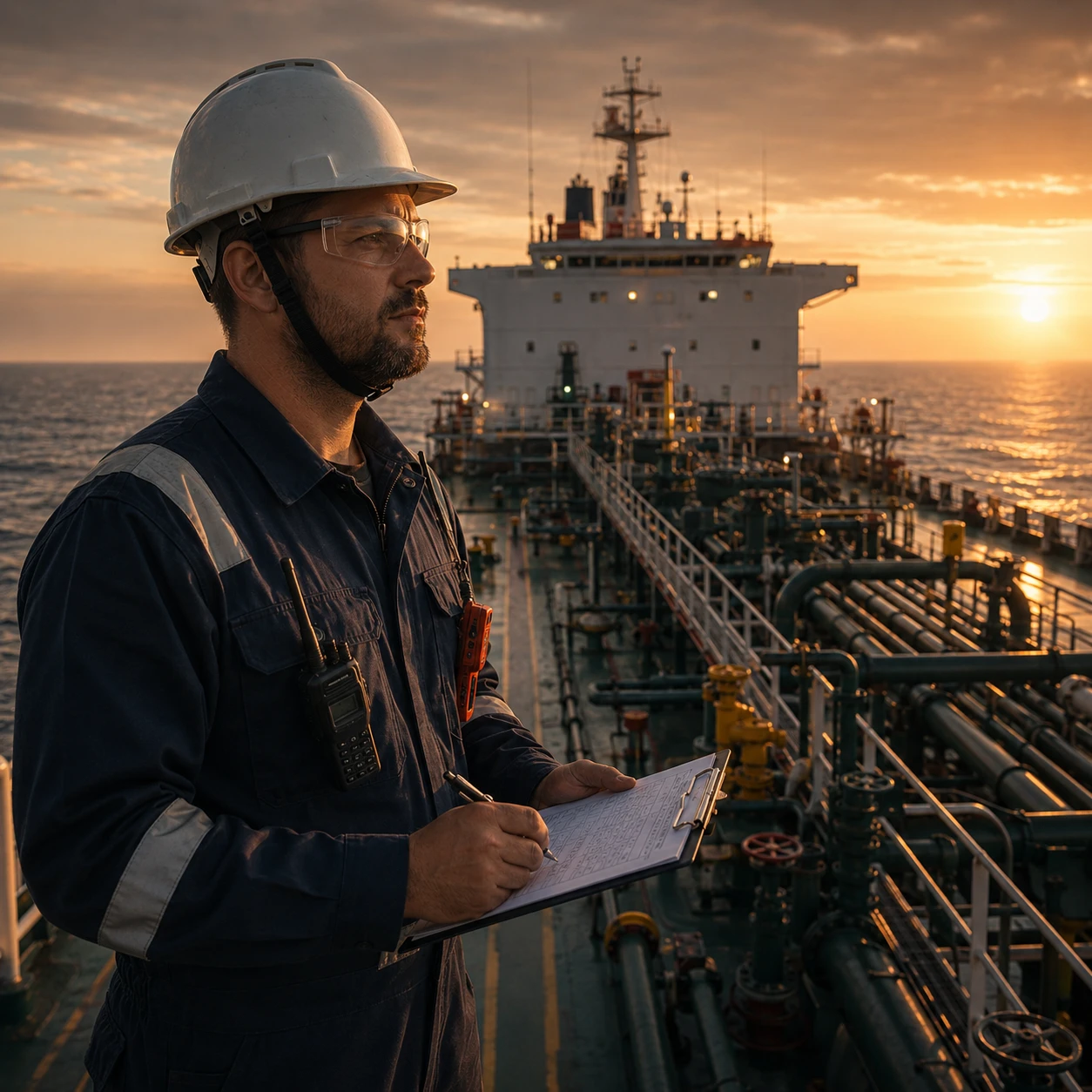
The course "Advanced Training for Oil Tanker Cargo Operations", also known as "Advanced Training for Oil Tanker Cargo Operations," is designed to prepare seafarers working on oil tankers for the safe and efficient execution of cargo operations. The course covers key aspects of working with oil cargoes, including legal and regulatory requirements, tanker construction and systems, physical and chemical properties of oil, the use of pumps and measuring instruments, as well as safety measures and emergency procedures. Special attention is paid to practical exercises on simulators that allow skills to be practiced in conditions as close to real as possible. The course aims to enhance participants' qualifications and provide them with the competencies to perform their duties at a high level.
STCW Standards: Convention, Section V/1-1, Paragraphs 3, 4, Code, Section A-V/1-1, Paragraph 2.
- Introduction Covers the main legal and regulatory requirements governing the operation of oil tankers, including international STCW and MARPOL standards.
- Legal and regulatory requirements:
- STCW provisions.
- MARPOL regulations.
- Legal and regulatory requirements:
- Oil Tanker Construction and SystemsStudy of types of oil tankers, their construction, and the systems and equipment used on tankers.
- Types of oil tankers:
- Structural features of different types of tankers.
- Main systems and equipment:
- Piping systems.
- Pumps and valves.
- Types of oil tankers:
- Physical and Chemical Properties of OilConsiders the characteristics of oil cargoes, their impact on stability and structural integrity of the vessel, as well as safety precautions.
- Physical and chemical properties of oil cargoes.
- Impact of oil properties on the operational characteristics of the vessel, stability, and integrity.
- Safe methods of working with oil cargoes.
- Pump Theory and CharacteristicsDescription of various types of pumps used on oil tankers, their technical characteristics, and operating principles.
- Types of pumps used on tankers.
- Basic operating principles of pumps and their technical parameters.
- Safety Culture and Safety Management on TankersStudy of safety management systems, planning and performing safe operations on oil tankers, and measures to prevent accidents and incidents.
- Main components of the safety management system.
- Processes for planning and implementing safe operations.
- General Safety Measures and Safety SystemsCovers the basic principles of ensuring safety, emergency shutdown systems (ESD), and measures to control and prevent pollution.
- Principles of ensuring safety on tankers.
- Emergency shutdown systems (ESD).
- Pollution control and prevention measures.
- Cargo Operations on Oil TankersPlanning and execution of loading and unloading operations, management and control of cargo operations, use of checklists and procedures to ensure safety.
- Planning and execution of loading and unloading operations.
- Management and control of cargo operations.
- Use of checklists and procedures.
- Measuring Instruments and Gas Control SystemsStudy of the principles of operation, accuracy, and limitations of various measuring instruments and gas control systems used on tankers.
- Principles of operation, accuracy, and limitations.
- Use and maintenance of measuring instruments.
- Responsibility for Cargo OperationsDescription of the duties and responsibilities of personnel, planning operations, and distributing duties to ensure the effective execution of cargo operations.
- Duties and responsibilities of personnel.
- Planning operations and distributing duties.
- Working Procedures and Safe PracticesInstructions for safe work, safety precautions when working with hazardous cargoes, and the application of best practices to minimize risks.
- Instructions for safe work.
- Safety precautions when working with hazardous cargoes.
- Emergency Procedures on TankersActions in case of accidents and emergencies, procedures for oil spill response, and providing first aid on tankers.
- Actions in case of accidents and emergencies.
- Oil spill response procedures.
- First aid on tankers.
- Fire Safety Measures and Emergency ActionsBasics of fire safety on tankers, planning, and implementation of fire safety measures to ensure the safety of crew and vessel.
- Basics of fire safety on tankers.
- Planning and implementation of fire safety measures.
- Environmental Protection ProceduresMeasures to prevent marine pollution, procedures in case of collision and grounding, and actions to minimize environmental damage.
- Measures to prevent marine pollution.
- Procedures in case of collision and grounding.
- Practical ExercisesPractical training using simulators to simulate cargo operations, conduct loading and unloading exercises, practice emergency situations and oil spill response actions.
- Working on simulators to simulate cargo operations.
- Conducting practical loading and unloading exercises.
- Practicing emergency situations and oil spill response actions.
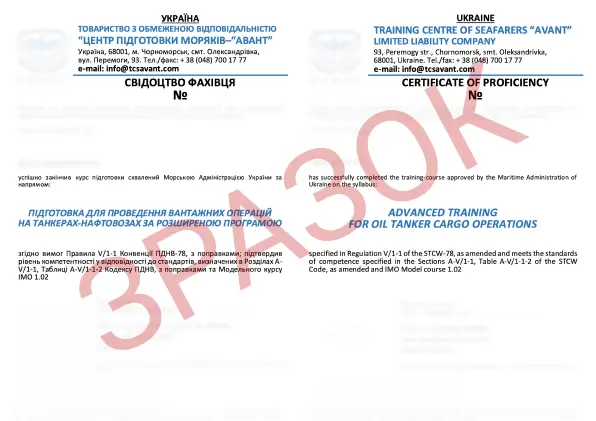
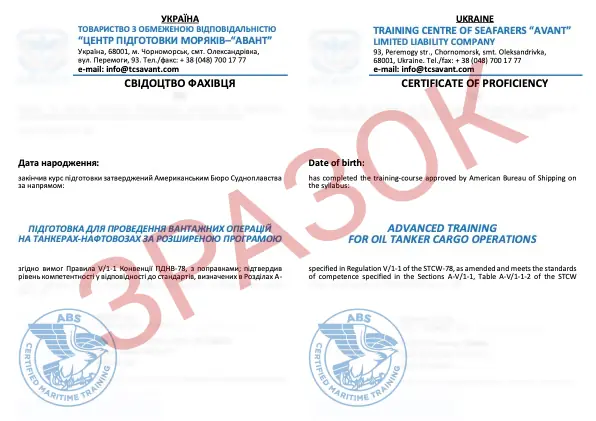
Upon successful completion of the training, participants receive an official certificate: Certificate of qualified specialist..
Course Reviews
Відмінний курс англійської! Ідеальне тренування вимови та морської термінології. Рекомендую всім морякам.
Гарна структура курсу та матеріали. Хотілося б більше практики з радіозв'язком.
Ідеально для початківців! Зрозумілі пояснення та багато практичних вправ. Моя впевненість значно покращилася.
How it works:
1. Choose us
We have been in the market for over 20 years. Our courses are certified and recognized worldwide.
2. Register
Complete online registration to save time. Choose a course and after registration and payment, you will get access to training without extra steps.
3. Complete the course
Training is available from any device: PC, laptop, tablet or smartphone (iOS/Android). You can choose online format or download materials.
4. Evaluate knowledge
Assessment is conducted in the form of a test with multiple choice questions. After successful completion of testing, you will receive a certificate.
5. Get certificate
The manager will email you the completed certificates. You can print the certificate at any time. If you prefer, you can request an original hard copy by mail.
How it works:
1. Choose us
We have been in the market for over 20 years. Our courses are certified and recognized worldwide.
2. Register
Complete online registration to save time. Choose a course and after registration and payment, you will get access to training without extra steps.
3. Complete the course
Training is available from any device: PC, laptop, tablet or smartphone (iOS/Android). You can choose online format or download materials.
4. Evaluate knowledge
Assessment is conducted in the form of a test with multiple choice questions. After successful completion of testing, you will receive a certificate.
5. Get certificate
The manager will email you the completed certificates. You can print the certificate at any time. If you prefer, you can request an original hard copy by mail.
Frequently Asked Questions
This course is mandatory for all seafarers, officers and ratings working on board a vessel, in accordance with STCW A-VI/6, p. 1.
To enroll in the course, you need a valid medical certificate and a valid seaman's passport.
After completion, you will know different security levels, emergency procedures, and be able to recognize and avoid threats.
The course covers information about different security levels, emergency procedures, threat recognition and avoidance methods. You will learn about ship security, port facility security, and relevant international regulations.
Yes, the course is fully online and can be completed remotely. You can access the materials at any time convenient for you, from any device with internet access.
Upon successful completion of the course, you will receive an internationally recognized certificate that complies with STCW requirements. The certificate will be available for download immediately after passing the final test.
Yes, the certificate is fully compliant with the International STCW Convention 78 (as amended) and is recognized by maritime administrations of Panama, Liberia, Marshall Islands, and the USA.
Yes, you can take the course from any country as long as you have a stable internet connection. Our platform is accessible worldwide, 24/7.
The course duration is flexible and depends on your learning pace. On average, it takes 2-3 days to complete all materials and pass the final test.
The course cost is competitive and includes all materials, tests, and certification. Please contact our managers for current pricing and available discounts.
The course is available in multiple languages including English, Ukrainian, and Russian. You can choose your preferred language when enrolling.