
Liquid Cargo and Ballast Handling on Oil Tankers
- Format: in-class and distance learning
- Language: ukranian, russian, english
- Price: 4000₴
About the Course
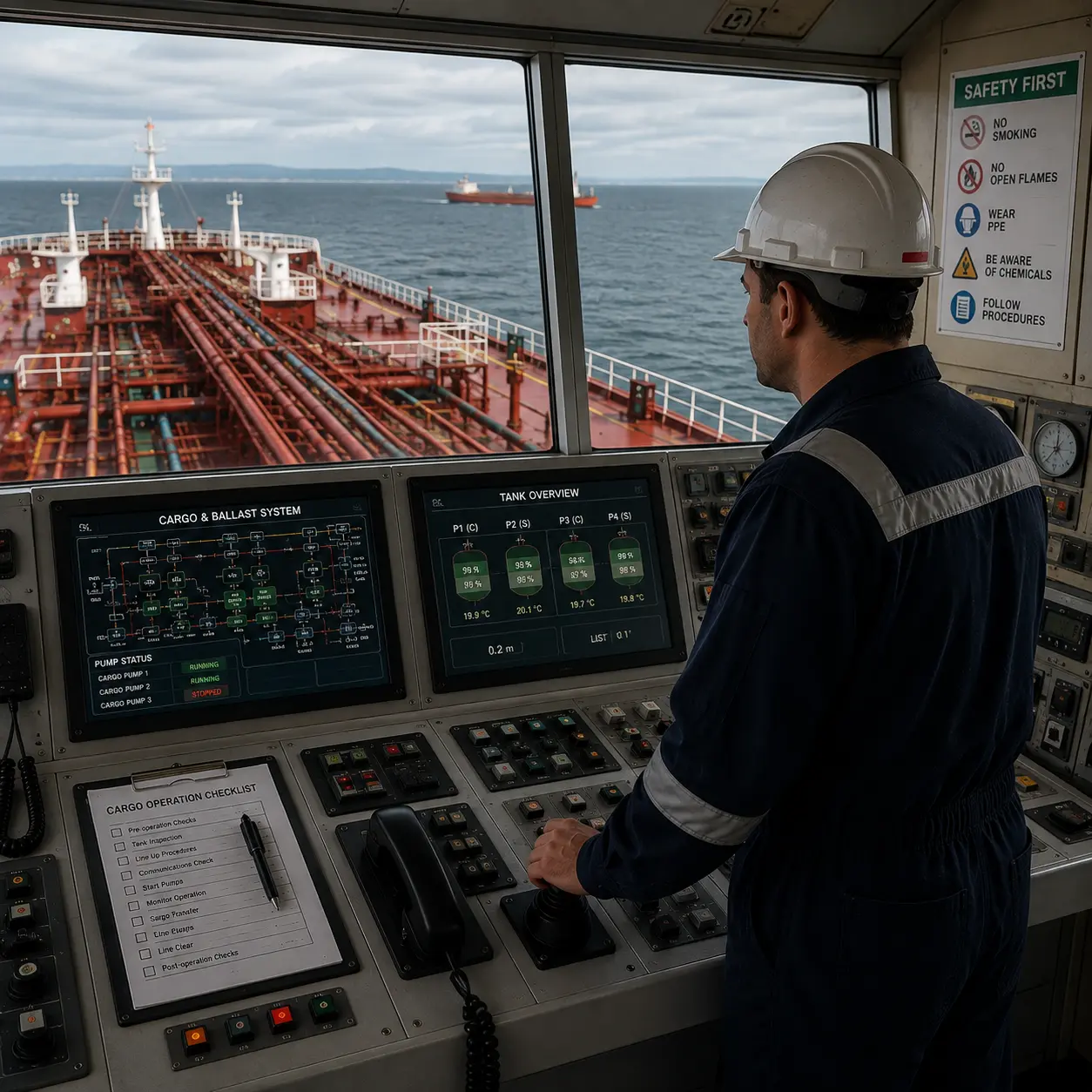
Liquid Cargo and Ballast Handling on Oil Tankers is a specialized practical training course designed for deck officers and personnel responsible for cargo and ballast operations on board oil tankers using a cargo handling simulator.
The training is conducted in accordance with STCW Convention Regulation V/1-1, as amended, STCW Code Section B-I/12, paragraph 71, as amended, and is based on the requirements of IMO Model Course 2.06 "Oil Tanker Cargo and Ballast Handling Simulator". The course is designed to develop practical competence in the safe operation of cargo and ballast systems, cargo handling equipment, monitoring of cargo operations, the safe transportation of crude oil and petroleum products, and effective decision-making during both routine and emergency situations.
During the training, participants perform the complete cargo handling cycle on an oil tanker, including cargo tank preparation, cargo loading, loaded voyage operations, cargo discharge, ballast operations, inert gas system operation, tank cleaning, cargo monitoring, operation of cargo control and emergency shutdown systems, as well as response to equipment failures and emergency situations.
Upon Completion of the Course, Participants Will Be Able To
- plan and conduct cargo and ballast operations on oil tankers safely and efficiently;
- operate cargo pumps, pipelines, valves, inert gas systems and auxiliary cargo equipment;
- monitor cargo tank levels, pressure, temperature and cargo condition throughout cargo operations;
- perform ballast and deballast operations in accordance with approved operational procedures;
- carry out tank cleaning and prepare cargo tanks for subsequent operations;
- operate cargo monitoring, alarm and Emergency Shutdown (ESD) systems;
- maintain vessel stability, trim and hull stress within safe operational limits during cargo operations;
- apply safe working practices when handling crude oil and petroleum products;
- respond effectively to equipment failures, cargo leaks and emergency situations;
- work effectively as part of the cargo handling team while ensuring the safety of personnel, the vessel and the marine environment.
Certification
Successful completion of the course, confirmed by passing the final test (and, where applicable, demonstrating practical competence), entitles the participant to receive a certificate of completion for the Liquid Cargo and Ballast Handling on Oil Tankers course.
The training is conducted in accordance with STCW Convention Regulation V/1-1, as amended, STCW Code Section B-I/12, paragraph 71, as amended, IMO Model Course 2.06 "Oil Tanker Cargo and Ballast Handling Simulator", and the training centre's approved training programme.
How it works:
1. Choose us
We have been in the market for over 20 years. Our courses are certified and recognized worldwide.
2. Register
Complete online registration to save time. Choose a course and after registration and payment, you will get access to training without extra steps.
3. Complete the course
Training is available from any device: PC, laptop, tablet or smartphone (iOS/Android). You can choose online format or download materials.
4. Evaluate knowledge
Assessment is conducted in the form of a test with multiple choice questions. After successful completion of testing, you will receive a certificate.
5. Get certificate
The manager will email you the completed certificates. You can print the certificate at any time. If you prefer, you can request an original hard copy by mail.
How it works:
1. Choose us
We have been in the market for over 20 years. Our courses are certified and recognized worldwide.
2. Register
Complete online registration to save time. Choose a course and after registration and payment, you will get access to training without extra steps.
3. Complete the course
Training is available from any device: PC, laptop, tablet or smartphone (iOS/Android). You can choose online format or download materials.
4. Evaluate knowledge
Assessment is conducted in the form of a test with multiple choice questions. After successful completion of testing, you will receive a certificate.
5. Get certificate
The manager will email you the completed certificates. You can print the certificate at any time. If you prefer, you can request an original hard copy by mail.
Frequently Asked Questions
This course is mandatory for all seafarers, officers and ratings working on board a vessel, in accordance with STCW A-VI/6, p. 1.
To enroll in the course, you need a valid medical certificate and a valid seaman's passport.
After completion, you will know different security levels, emergency procedures, and be able to recognize and avoid threats.
The course covers information about different security levels, emergency procedures, threat recognition and avoidance methods. You will learn about ship security, port facility security, and relevant international regulations.
Yes, the course is fully online and can be completed remotely. You can access the materials at any time convenient for you, from any device with internet access.
Upon successful completion of the course, you will receive an internationally recognized certificate that complies with STCW requirements. The certificate will be available for download immediately after passing the final test.
Yes, the certificate is fully compliant with the International STCW Convention 78 (as amended) and is recognized by maritime administrations of Panama, Liberia, Marshall Islands, and the USA.
Yes, you can take the course from any country as long as you have a stable internet connection. Our platform is accessible worldwide, 24/7.
The course duration is flexible and depends on your learning pace. On average, it takes 2-3 days to complete all materials and pass the final test.
The course cost is competitive and includes all materials, tests, and certification. Please contact our managers for current pricing and available discounts.
The course is available in multiple languages including English, Ukrainian, and Russian. You can choose your preferred language when enrolling.