
How to Get a Crab Boat Job in Norway as a Beginner
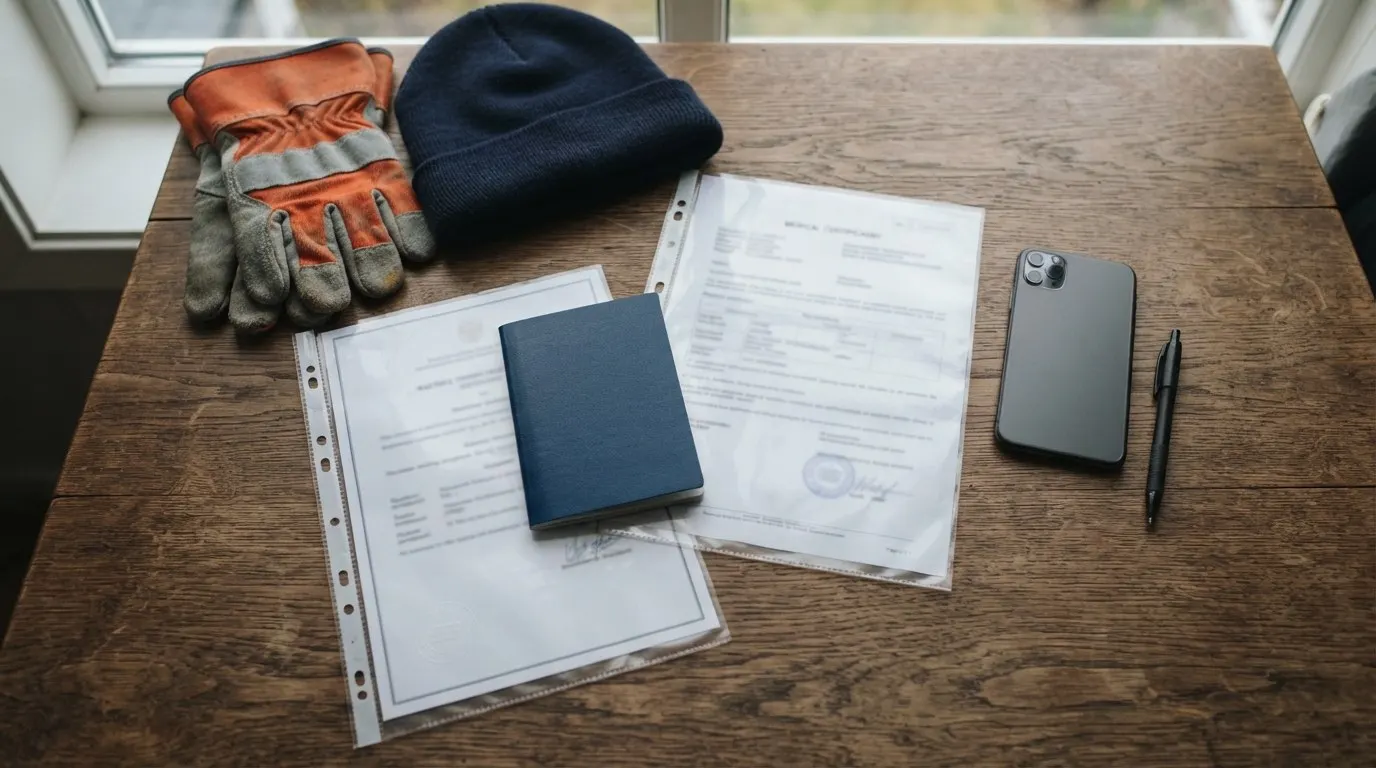
To get a crab fishing job in Norway as a beginner, you need a passport, the right to work in Norway, a medical certificate and safety training; many employers ask for STCW Basic Safety Training, although Norwegian rules also set a separate safety course for fishermen. Ask the employer which safety certificate they accept before you pay for a course, and an AVANT manager will help you choose the right document for your passport. AVANT's Basic Safety course has passed an ABS quality audit and is approved by the Liberian International Ship and Corporate Registry (LISCR).
Crab boat jobs in Norway: what the work involves
Planning to work on a crab boat? Message our manager and we will work out which safety certificate you need.
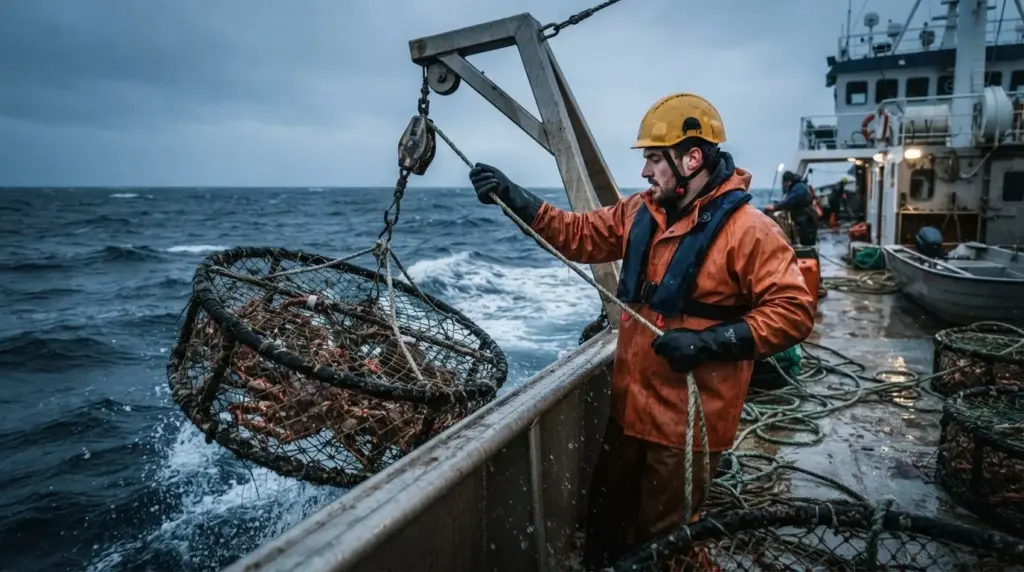
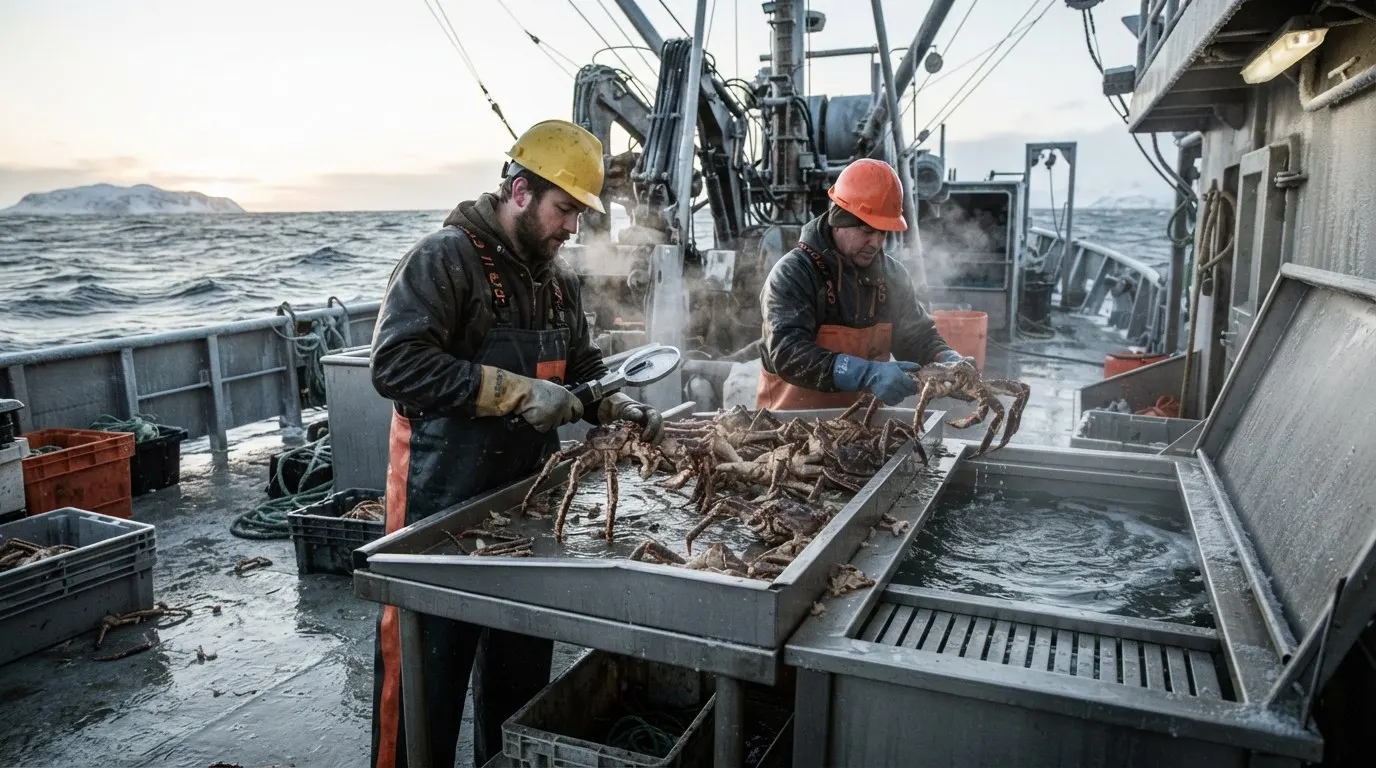
A crab boat sets pots (crab traps) on the seabed and hauls them back aboard after a few hours or days in the water. As a beginner you work on deck: taking pots out of the water, emptying them and sorting the catch. It is physical work in the cold, on a wet deck next to a hauler.
Most of our students who go crab fishing head for Norway, where crews catch red king crab and snow crab in the Barents Sea.
A Moldovan fisherman from Chișinău, who spent several years on Norwegian crab boats and later opened a consultancy for newcomers, described the job in interviews in 2021–2023. He spoke of 8-hours-on, 8-hours-off shifts, heavy fatigue in the first weeks, and beginners sometimes being given extra unpaid four-hour watches.
Norway or Alaska?
Search for crab fishing jobs in English and most results lead to Alaska. Under US law, unlicensed crew on American fishing vessels must be US citizens, permanent residents or other foreigners with US work authorization, and that last group may make up no more than a quarter of the unlicensed crew. Without the right to work in the United States you cannot be hired there, so look at Norway.
Can foreigners work on fishing boats in Norway?
The passport you travel on decides the route.
Citizens of EU and EEA countries, including Romania and Bulgaria, work in Norway under EEA rules and do not need a separate work permit. If you hold two passports, decide in advance which one you will travel on and issue every document in that name, including your safety certificate. The spelling of your name must match your passport exactly.
Citizens of other countries need a residence permit for work, issued by the Norwegian Directorate of Immigration (UDI). According to UDI, the exemption for seafarers on international voyages does not cover fishing vessels that land their catch in Norway. Find out from your employer who applies for the permit and on what basis before you travel.
Crab boat salary: how much do crews earn?
How pay is calculated
On Norwegian fishing vessels the crew is usually paid a share of the catch value, a system Norwegians call lott. The same fisherman said in a 2023 interview that up to half of the vessel's net revenue is shared among the crew. Your earnings therefore depend on the size of the catch, the price the crab sells for and the share written into your contract.
His own figures show how much this varies. On his first boat he was paid 1,200 US dollars a month plus 40 dollars per tonne of catch, and his best month came to 4,800 dollars when he had expected 5,000. Later he earned about 4,000 euros a month, and after that about 70,000 Norwegian kroner.
What job ads promise
Recruiters advertise higher numbers. An Oslo staffing agency hiring for the 2026–2027 season promises 9,000 to 12,000 euros a month for offshore crab fishing. Another ad for a Norwegian crab boat lists 7,000 euros for a month at sea, 4,500 euros for a month off and a percentage of the catch. These are promises in ads. There are no official statistics on what beginners earn on crab boats.
Deductions to watch for
According to the same fisherman, oilskins and other work gear cost around 1,000 euros and may be deducted from your pay. He also said that early in his career foreign crew were paid less than they were owed.
Before you travel, ask for these points in writing:
- your share or fixed amount and how it is calculated;
- what is deducted: gear, food, accommodation, tickets;
- who pays for travel to the vessel and back;
- the length of the contract and the terms for ending it early.
Contract, schedule and season
How long a contract lasts
Contracts in job ads run from 3 to 12 months. In 2023 the same fisherman described trips of up to 218 days, with the boat calling at port roughly every four weeks. He said employers often buy the tickets and help with police and tax registration. Agree in advance who pays for what.
When the season runs
Crab fishing in Norway is regulated by the Ministry of Trade, Industry and Fisheries, and quotas and closed periods change every year.
For snow crab, the season opens early in the year. According to the same fisherman, there is no work from July to September, when the crab moults, and that a year usually gives between one and nine months of work.
For red king crab, in 2026 the fishery was closed from March to May, and May was closed for the first time. Check the 2027 rules closer to the season.
Crab boat or crab factory?
Onshore crab processing plants hire roughly from June to November, and their ads usually do not ask for a sea safety course. If someone offers you "crab work in Norway", ask whether it is a vessel or a factory, because that decides which documents you need.
A vessel may send an offer shortly before it sails, and documents take time. Have yours ready before you start sending out your CV.
How to find work and avoid scams
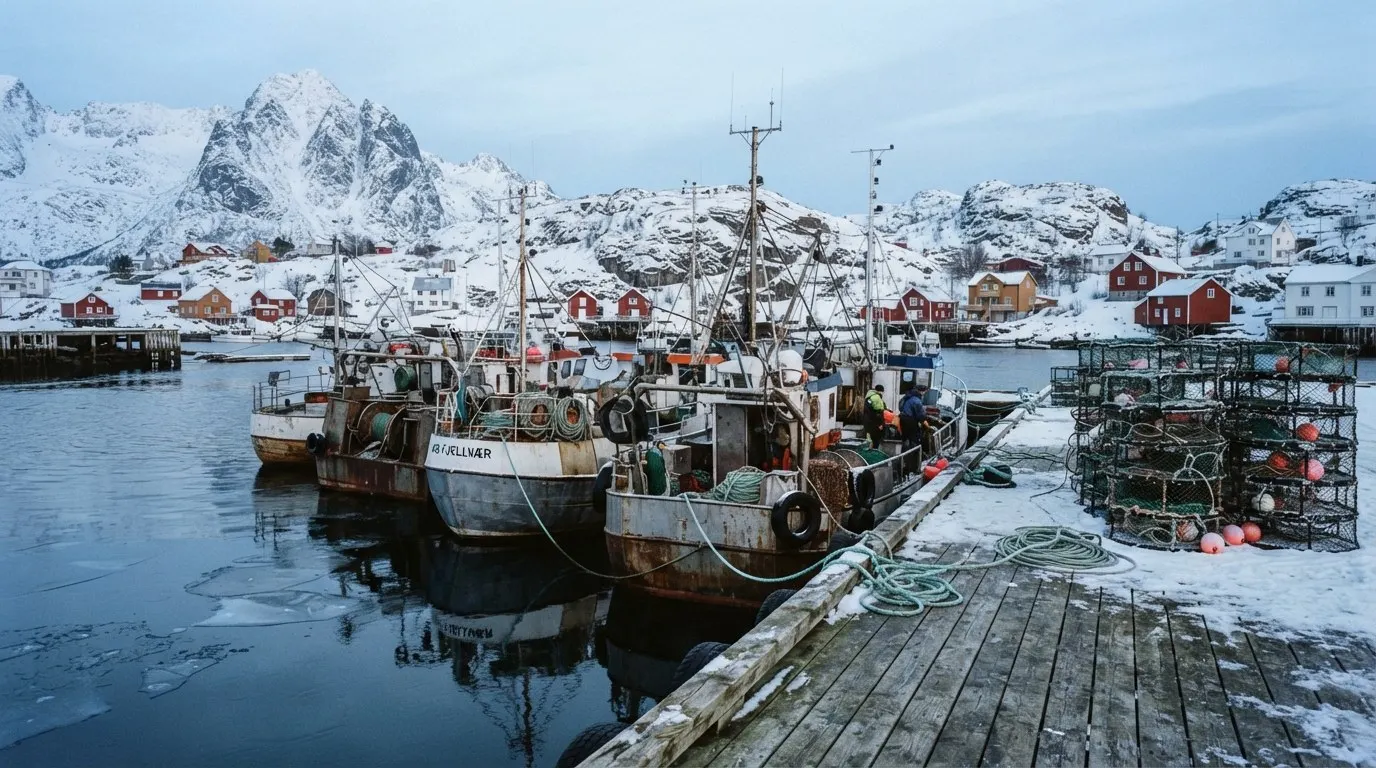
We found no crab boat vacancies on finn.no, Norway's largest job site. People find these jobs through contacts already working in Norway, by writing directly to vessel owners, or through agencies. The Moldovan fisherman sent about two thousand CVs to Norwegian companies, heard back from only a handful, and got his first offer from a boat with a Russian-speaking crew. A young Moldovan who fished crab in the Barents Sea told a Romanian outlet that each of his three boats had Romanians on board. It helps to find people from your own country who already work on crab boats.
Keep your CV in English short: physical work experience, documents you already hold, when you can travel, contact details. Basic English matters on board, but you do not need it for the course, which is also available in Ukrainian and Russian. After a fisherman died in 2023, falling overboard from a crab boat in the Barents Sea, the Norwegian Maritime Authority (Sjøfartsdirektoratet) carried out unannounced inspections of crab boats with a focus on working language and communication on board, and the accident investigation board recommended that crews have the English skills they need.
Some intermediaries are scammers. UDI has a page on fraudulent job offers, and in March 2026 the recruiter Faststream warned that people were offering jobs in the Norwegian fishing fleet on Telegram in its name. Genuine recruiters, it said, do not charge for visas or placement. Be careful if someone:
- !asks you to pay upfront "for the visa", "for the contract" or "for the job";
- !talks only through a messenger, with no company name, vessel or address;
- !promises high pay without explaining how it is made up;
- !says you can board without documents or training, but must pay today.
Recruiter ads usually say that no experience or language skills are needed, yet they set age and gender limits: one of them takes only men aged 19 to 55 for offshore fishing.
Documents a beginner needs
What STCW Basic Safety Training is
Basic Safety Training (BST) is the entry-level safety training set by the international STCW Convention for seafarers. It has four parts: personal survival techniques, fire prevention and firefighting, elementary first aid, and personal safety and social responsibilities. From 1 January 2026 the last part also covers preventing violence, harassment and bullying on board.
Does STCW apply to fishing vessels?
Not directly. The STCW Convention itself excludes fishing vessels, and fishermen are covered by the rules of the vessel's country. In practice, many employers and agencies still ask new crew for STCW Basic Safety, and it is up to them which certificate they accept.
Will a Norwegian employer accept the certificate?
For crew on Norwegian fishing vessels, Norwegian rules require a separate safety course for fishermen (sikkerhetsopplæring for fiskere). It is run by centres approved by the Norwegian Maritime Authority, the recommended length is 50 hours over 5 days with practical training, and the certificate is valid for 8 years. Norwegian sources do not say directly whether international Basic Safety is accepted instead.
In our experience, most employers accept the AVANT certificate, but there are exceptions. Ask your employer or agency to name the document they will accept in writing, and show them a sample before you pay for training. The same applies to the UK, Ireland, Iceland and the Faroe Islands, which also have their own safety courses for fishermen.
Basic Safety at AVANT
AVANT is a seafarers' training centre in Odesa, Ukraine, operating since 2003. Its Basic Safety course has passed a quality audit by the American Bureau of Shipping (ABS), certificate No. ATH250724, valid until 24 July 2028. The course is also approved by the Liberian Registry (LISCR).
For international students
You receive a certificate issued by the AVANT training centre. You study by distance learning on the AVANT platform at your own pace: 23 lessons with instructor videos and study notes, in English, Ukrainian or Russian. At the end there is a final test of 16 questions, and you need at least 12 correct answers to pass.
The certificate is sent to your email and is valid for five years. No paper copy is issued; you can print and laminate the electronic document.
Ukrainian citizens receive a certificate entered in the register of the Maritime Administration of Ukraine; the manager will explain the format and timing of their training.
Every document carries a QR code that opens a verification page on the AVANT website. Before you send it to an employer, check that your name and date of birth match your passport.
How to enrol
- 1Message our manager on Telegram, WhatsApp or Instagram. Tell us where you are going and which passport you will travel on.
- 2The manager will tell you which document fits your case and send a sample so you can show it to your employer in advance.
- 3Send a scan of your passport (and national ID card if you have one), a digital passport-style photo (3×4 cm), your email address and a medical certificate if you have one.
- 4The manager will tell you the price before you pay and send the invoice as a link. You can forward it to a relative if they are paying.
- 5Complete the training and receive your certificate.
Is crab fishing dangerous?
Crab fishing has long been seen as one of the most dangerous jobs at sea, and Alaska shows best how safety rules changed it. In the late 1990s an average of eight people a year died on Bering Sea crab boats. After the US Coast Guard introduced pre-season stability checks in 1999, deaths fell to fewer than one a year, according to the US National Institute for Occupational Safety and Health (NIOSH).
The main risks for deck crew are falling overboard and cold water. Of all commercial fishing deaths in Alaska in 2000–2019, nearly a third were falls overboard and three quarters were drownings. In Norway, according to the Maritime Authority's report, three people died on fishing vessels in 2025.
The Basic Safety course covers what to do in cold water: lifejackets and immersion suits, the man-overboard alarm and ways to keep warm. Alone, you hold the HELP position with your knees drawn to your chest; in a group, you huddle tightly together. First aid for hypothermia is covered too, because a doctor may be days away at sea.
Frequently asked questions
How much does a beginner earn on a crab boat?
Crews are usually paid a share of the catch value. The Moldovan fisherman we quoted earned 1,200 dollars a month plus a bonus per tonne on his first boat, while recruiter ads for 2026–2027 promise 9,000 to 12,000 euros a month for offshore crab fishing or, in another ad, 7,000 euros for a month at sea. Check your share, advances and deductions in the contract.
I am from Moldova but have a Romanian passport. Which one should I use?
The one you will travel on to work. With a Romanian passport you work in Norway as an EU citizen, so issue all your documents, including the safety certificate, in that passport.
Do I need experience?
Recruiter ads usually say no experience is needed. Prepare your documents and safety training in advance; basic English gives you an advantage.
Can foreigners work on Alaskan crab boats?
Only if you are a US permanent resident or have US work authorization, and crew in the second group may make up no more than a quarter of the unlicensed crew.
Can I take STCW Basic Safety by distance learning?
Yes, international students at AVANT study on our platform and receive the certificate by email. Whether your employer accepts it is their decision, so ask them before you pay.
Will a Norwegian employer accept the AVANT certificate?
In our experience, most employers do, but there are exceptions. Ask your employer to confirm in writing which document they accept, and show them a sample before you pay.
How will an employer verify my certificate?
Through the QR code on the document, which opens a verification page on the AVANT website.
How do I pay from abroad?
We send an invoice with a payment link, and you can forward it to someone else. If paying from your country does not work, message the manager.
Message an AVANT manager
If you are heading for a crab boat and need basic safety training, message an AVANT manager on Telegram, WhatsApp or Instagram. We will tell you which document suits you and help you start your training.
Need to update documents or choose courses for a new contract?
Fill out the seafarer application — our specialists will help determine the required certificate package.
Or contact us directly:
Working hours:
Monday—Thursday: 9:00 AM to 5:00 PM
Friday: 9:00 AM to 4:00 PM
Saturday and Sunday — days off