
What the Crew Must Know About Ship Security

A rating who has no duties assigned in the ship security plan needs security-awareness training; someone entered in the security plan with specific duties needs the designated security duties course; and the ship security officer (SSO) course is only for the person the company has appointed to that role. STCW regulations VI/6 and VI/5 are built exactly this way: familiarization and security-awareness instruction for all seafarers, a separate standard for those with designated duties, and a third one, under regulation VI/5, for the SSO. A deck rating is not expected to become a security specialist — only to know their own part of the plan.
What ISPS Is and Why the Crew Needs It
The International Ship and Port Facility Security Code (ISPS Code; the Ukrainian text of STCW uses its own Ukrainian abbreviation for it) entered into force on 1 July 2004 under SOLAS chapter XI-2; Part A is mandatory, Part B is guidance. It was adopted on 12 December 2002 by resolution of the Conference of Contracting Governments to SOLAS. "Security duties" in STCW are all security tasks and duties on board ships under SOLAS chapter XI-2 and the ISPS Code.
The Code applies to passenger ships, cargo ships of 500 gross tonnage and upwards and mobile offshore drilling units on international voyages, as well as to the port facilities serving them; it does not apply to warships. Governments, ports and companies appoint their own security officers: a PFSO (port facility security officer) in the port, an SSO (ship security officer) on the ship and a CSO (company security officer) in the company.
Three documents and roles the crew deals with. The ship security plan (SSP) is a plan for applying on board measures that protect persons, cargo, stores and the ship from the risks of a security incident. The SSO is the person on board, accountable to the master, designated by the company as responsible for the security of the ship, including implementation and maintenance of the SSP and liaison with the CSO and PFSOs. The CSO is the person designated by the company to ensure that a ship security assessment is carried out, that an SSP is developed, submitted for approval, and thereafter implemented and maintained, and to liaise with PFSOs and the SSO. The company is responsible for familiarizing seafarers with their duties and for coordinating the actions of personnel during functions important to security.
Part B of the STCW Code (guidance) says it plainly: seafarers and shipboard personnel are not security experts, and the aim of the provisions of the Convention or the Code is not to turn them into security specialists.

The Three Security Levels in Plain Words
Security level 1 means minimum protective measures maintained at all times. Level 2 means additional measures for a period of heightened risk of an incident. Level 3 means further specific measures for a limited period when an incident is probable or imminent.
What this means for a rating at level 1: on all ships, security duties are performed, access to the ship is controlled, the embarkation of persons and their effects is controlled, restricted areas, deck areas and areas surrounding the ship are monitored, the handling of cargo and stores is supervised, and security communication must be readily available. At levels 2 and 3, the same actions are stepped up according to the security plan of the specific ship.
The threats considered include damage to or destruction of the ship by explosives or arson, hijacking of the ship or seizure of persons, tampering with cargo or equipment, unauthorized access including stowaways, smuggling of weapons, use of the ship as a weapon, and attacks from seaward while at berth or at anchor.
What Every Seafarer Must Know
All seafarers must receive security-related familiarization and security-awareness training or instruction in accordance with section A-VI/6. If security awareness is not included in the requirements of their certificate of competency, a separate certificate of proficiency is issued.
There are two different steps here. The first is familiarization training on board: before being assigned to a ship covered by the ISPS Code, all persons other than passengers must learn to report incidents, know the procedures to follow when they recognize a threat, and take part in emergency procedures. It is given by the SSO or an equally qualified person. The second is a security-awareness course or instruction under table A-VI/6-1, with an examination or continuous assessment, which a seafarer without designated duties completes before being assigned any shipboard duties.
Table A-VI/6-1 has three areas of competence: contributing to the enhancement of maritime security through heightened awareness; recognizing security threats; understanding the need for and methods of maintaining security awareness and vigilance. The level of knowledge is "basic": terms and definitions, international maritime security policy, security levels, reporting procedures, security-related contingency plans, techniques used to circumvent security measures, recognition of threats, weapons and dangerous substances, confidentiality, and requirements for drills and exercises. Part B of the ISPS Code says the same about all other crew members without specific duties: they should know the relevant provisions of the security plan, the meaning of the security levels, emergency procedures, how to recognize weapons, dangerous substances and suspicious persons — without discrimination — and the techniques used to circumvent security measures.
What Is Added if You Are Entered in the Security Plan
"Persons with designated security duties" are those who have specific security duties and responsibilities in accordance with the ship security plan. The criterion is not the rank but an entry in the SSP: access control, checking persons and their effects at embarkation, physical searches. Such seafarers must meet paragraphs 6–8 of section A-VI/6, and if this is not included in their certificate of competency, they must obtain a separate certificate of proficiency. Before being assigned their duties, they complete familiarization training specifically for those duties.
The standard is table A-VI/6-2, with an examination or continuous assessment, including countering terrorism, piracy and armed robbery. Four areas: maintaining the conditions set out in the ship security plan; recognizing security risks and threats; carrying out regular security inspections; proper use of security equipment and systems. The knowledge adds the Declaration of Security, crowd management, physical searches and non-intrusive inspections, monitoring of restricted areas, access control, inspections of cargo and stores, and security equipment and its calibration. The ISPS Code requires such personnel to understand their duties under the SSP and to have sufficient knowledge.
Who the SSO Is and What They Need
Under STCW, the ship security officer is the person on board, accountable to the master, designated by the company as responsible for the security of the ship and for the security plan. The ISPS Code lists ten duties: regular security inspections, maintaining the SSP, coordinating security for cargo and stores, proposing modifications to the plan, reporting non-conformities to the CSO, enhancing security awareness and vigilance on board, ensuring training of shipboard personnel, reporting all security incidents, coordinating with the CSO and PFSOs, and keeping security equipment in working order.
Admission requirement: a candidate for an SSO certificate must have approved seagoing service of not less than 12 months, or appropriate seagoing service and knowledge of ship operations, and must meet section A-VI/5. The Administration ensures that such a person is issued a certificate of proficiency. Competence is demonstrated under table A-VI/5 — five areas: maintaining and supervising the implementation of the security plan; assessing security risk, threat and vulnerability; carrying out regular inspections of the ship; ensuring that security equipment and systems are properly operated; encouraging security awareness and vigilance. A practical demonstration of physical searches and non-intrusive inspections is required, as well as knowledge of internal audits, modifications to the plan and the Declaration of Security. The title of the certificate under regulation VI/5 is "ship security officer". Part B of the STCW Code adds: after training, the SSO should know enough English to understand and draw up security messages.
Temporary replacements are possible only by decision of the flag Administration and only as a Part B recommendation: in a case of absolute necessity, a seafarer with security duties may be allowed to act as SSO temporarily until the next port of call or for not more than 30 days, whichever is greater.
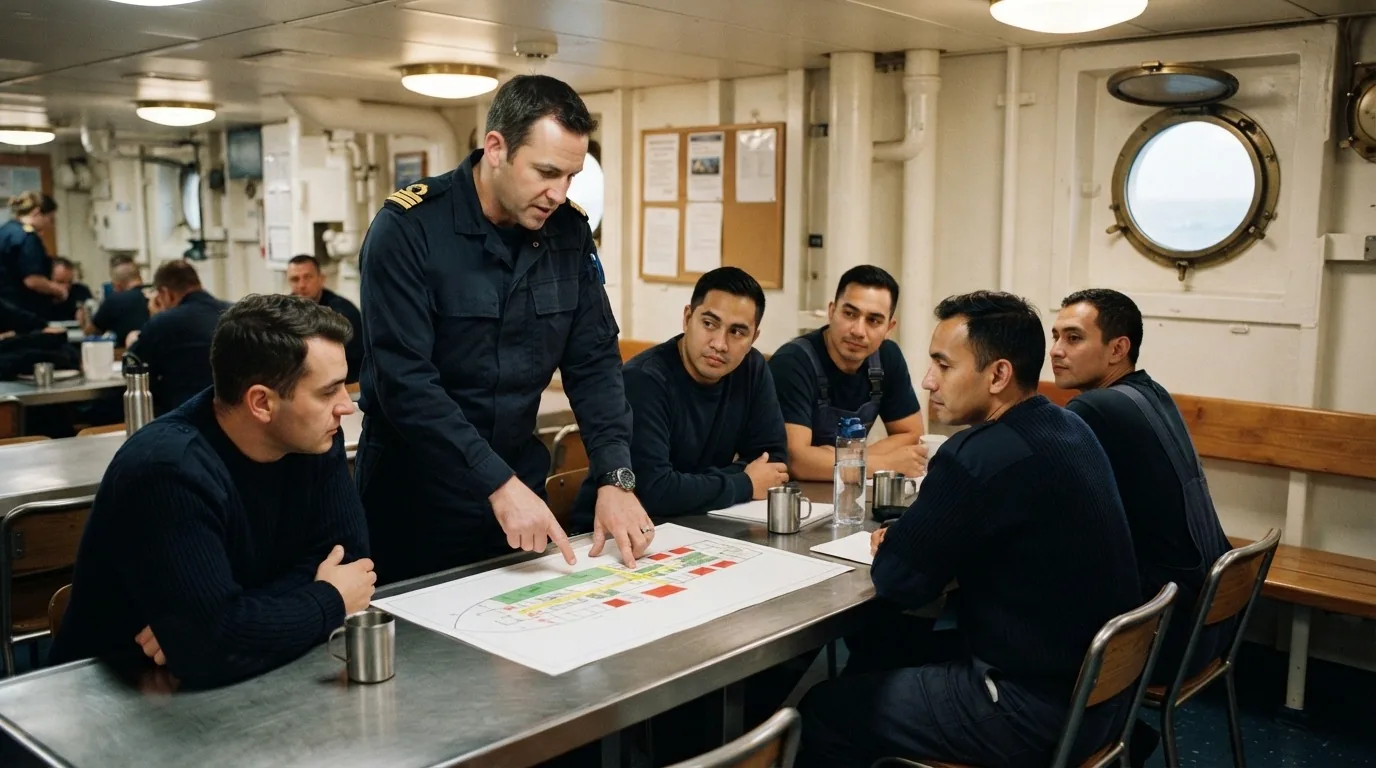
Drills and Exercises on Board
Part A of the ISPS Code requires drills at appropriate intervals, taking into account the ship type, crew changes and port facilities. Specific intervals are given in Part B; the Code presents them as guidance, while EU member states apply these paragraphs as mandatory. Security drills: at least once every three months, and if more than 25 percent of the crew has been changed with personnel who have not taken part in a drill on that ship within the last three months — within one week of the change. Exercises, which may involve CSOs, PFSOs, authorities and SSOs, are held at least once each calendar year with no more than 18 months between them.
Which Training You Need
| Who you are on board | STCW requirement | Training under STCW |
|---|---|---|
| Rating with no security duties in the ship security plan | regulation VI/6, paragraphs 1–2; A-VI/6, paragraph 4; table A-VI/6-1 | security-awareness training |
| Seafarer with security duties designated in the security plan | regulation VI/6, paragraphs 4–5; A-VI/6, paragraphs 6–8; table A-VI/6-2 | training for designated security duties |
| Officer appointed SSO by the company | regulation VI/5; A-VI/5; table A-VI/5 | ship security officer (SSO) training |
Security courses at the AVANT training centre: Ship Security Awareness Course for Shipboard Personnel, Ship Security Training for Designated Duties and Ship Security Officer (SSO) Training Course. For the conditions, format, duration and programme, see the course pages.
Do not confuse them with another course at the centre — Ship Safety Officer: it is a course on safety and the ISM Code, not on security. Safety and security are different things, and so are the documents for them.
How Long the Certificate Is Valid and Whether It Needs Renewal
Under STCW, a seafarer without designated duties completes security-awareness training at least once in their seagoing career; no refresher or revalidation is required if they undergo familiarization under regulation VI/6 and take part in drills and exercises under the ISPS Code. The same applies to designated security duties. This is a Part B provision, i.e. a recommendation, but it is consistent with the mandatory part: the five-year revalidation under regulation I/11 applies to certificates under all chapters except chapter VI. In the list of documents in table B-I/2, the revalidation column for VI/5 and VI/6 says "No".
In Ukraine, the certificate of proficiency as ship security officer has no expiry date. Also without expiry are the certificate in security-related familiarization training for officers, which is also attested by the certificates of competency of masters, deck officers, engineer officers and electro-technical officers, and the certificate of proficiency in ship security — for officers with security duties. Annex 1 to the Regulations does not require revalidation for VI/5 and both VI/6 certificates, but it does require registration in the State Register of Seafarers' Documents. For ratings, certificates of proficiency by position — from a rating forming part of a navigational watch to a ship's cook — have no expiry date and do not require revalidation.
What a Ukrainian Seafarer Needs
For ratings, the Rules for the certification of ratings name one security document: the certificate of proficiency in security-related familiarization training, issued to all ratings. Without it you cannot obtain a certificate as a rating forming part of a navigational watch, a rating forming part of an engine-room watch, an electro-technical rating or a ship's cook: the requirements for each include a certificate in basic safety training and a certificate in security-related familiarization training. A copy of this certificate is attached to the application.
The Ukrainian certificate under regulation VI/6 for all seafarers is called the certificate in security-related familiarization training. In STCW terms, it certifies a course of security-awareness training. Familiarization training on board, given by the SSO, is a separate requirement. For officers, the requirement is built into admission: masters and officers (except on fishing vessels) are admitted to any shipboard duties only after training under the Convention that includes ship security.
The Manila amendments to STCW were adopted on 25 June 2010 and have been in force since 1 January 2012; among the new elements are new requirements for security training and for actions in case of a pirate attack.
Frequently Asked Questions
Does a deck rating need the Designated Security Duties course?
Only if specific security duties are assigned to them in the ship security plan. Without such duties, security-awareness training under table A-VI/6-1 is enough.
Does the security certificate have to be renewed every five years?
Not under STCW: regulation I/11 on five-year revalidation does not apply to chapter VI, and Part B states directly that no refresher is required provided the seafarer takes part in drills on board. In Ukraine, security certificates for officers have no expiry date.
Who gives the first security briefing on board?
The SSO or an equally qualified person — before the seafarer takes up duties on a ship covered by the ISPS Code.
How much sea service do you need to become an SSO?
At least 12 months of approved seagoing service, or appropriate seagoing service and knowledge of ship operations — plus compliance with section A-VI/5.
Ship security rests on everyone on board knowing their own part of the plan — from the rating at the gangway to the officer who holds the keys to the SSP. For every seafarer, this path begins with security-related familiarization and security-awareness training.
Which security duties are assigned to you is determined by the security plan of the specific ship and by the company.
Need to update documents or choose courses for a new contract?
Fill out the seafarer application — our specialists will help determine the required certificate package.
Or contact us directly:
Working hours:
Monday—Thursday: 9:00 AM to 5:00 PM
Friday: 9:00 AM to 4:00 PM
Saturday and Sunday — days off