
Basic Fire Fighting vs Advanced Fire Fighting
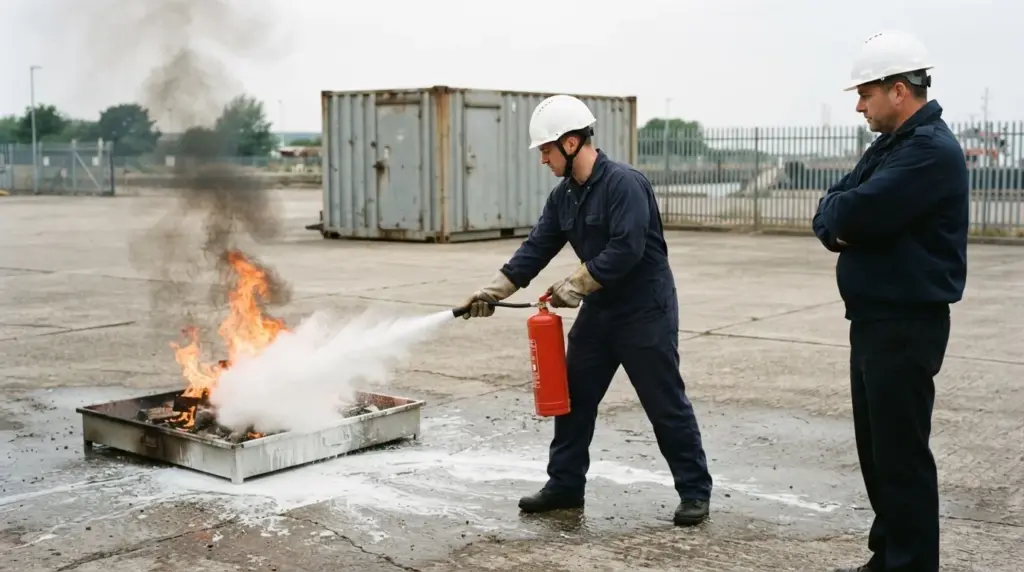
The STCW Convention has two different levels of training in shipboard fire fighting, and they do not replace each other. The basic level is Table A-VI/1-2 of the STCW Code, one of the four elements of Basic Safety Training: it is required of every seafarer whose duties relate to safety or pollution prevention, and it teaches you to fight a fire yourself. The advanced level is Regulation VI/3 and Table A-VI/3 (Advanced Fire Fighting): it is required of those designated to control fire-fighting operations, is part of the requirements for most officers' certificates of competency, and teaches you to command rather than to extinguish.
Two Levels in One Convention
The STCW Convention, as amended by the 2010 Manila amendments, describes fire fighting in two places in Chapter VI.
Regulation VI/1 and Section A-VI/1 of the Code cover basic safety training. Paragraph 2 of Section A-VI/1 requires seafarers employed or engaged in any capacity on board with safety or pollution-prevention duties to receive, before being assigned to any shipboard duties, approved basic training or instruction in four subjects, including fire prevention and fire fighting under Table A-VI/1-2. This is the basic level.
Regulation VI/3 and Section A-VI/3 cover training in advanced fire fighting. Paragraph 1 of Regulation VI/3 addresses a different group: seafarers designated to control fire-fighting operations shall have successfully completed advanced training in techniques for fighting fire, with particular emphasis on organization, tactics and command, and shall meet the standard of competence specified in Section A-VI/3. This is Advanced Fire Fighting.
The difference is not in the number of hours but in the role. The basic level trains a member of the fire party; the advanced level trains the one who commands that party.
The Basic Level: What Table A-VI/1-2 Requires
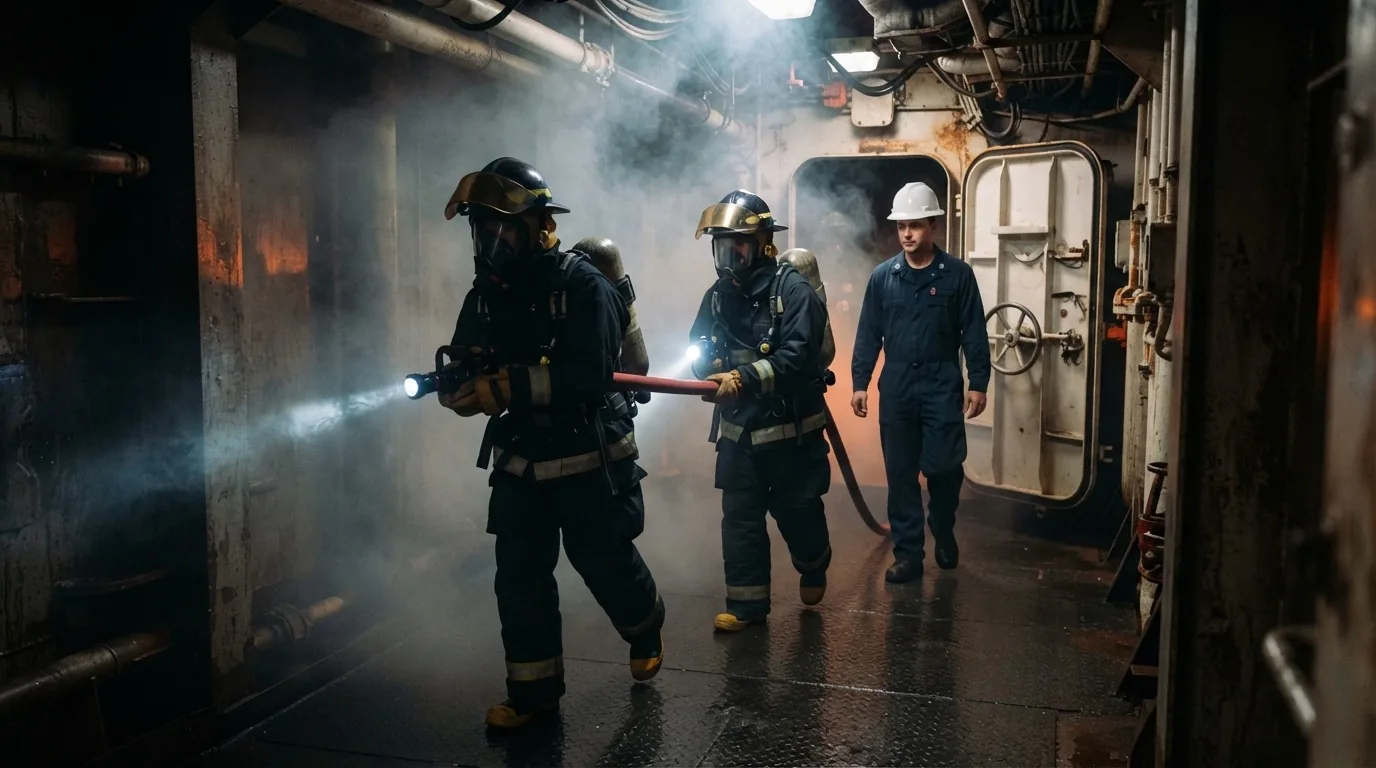
Table A-VI/1-2 contains two areas of competence. The first is minimizing the risk of fire and maintaining a state of readiness: shipboard fire-fighting organization, the location of fire-fighting appliances and emergency escape routes, the fire triangle, ignition sources, fire and smoke detection, classes of fire and extinguishing agents. The second is fighting the fire itself: fixed installations, fire-fighter's outfit, breathing apparatus, fire-fighting methods and procedures.
Column 3 describes the assessment, and this is why a basic course is never purely theoretical: practical demonstration in conditions close to shipboard ones and, wherever practicable, in darkness. The candidate must show the ability to use various types of portable fire extinguishers and self-contained breathing apparatus, extinguish small fires (electrical, oil, propane) and extensive fires with water, foam or powder, work in a smoke-filled enclosed space and rescue a person from it.
The Advanced Level: What Table A-VI/3 Requires
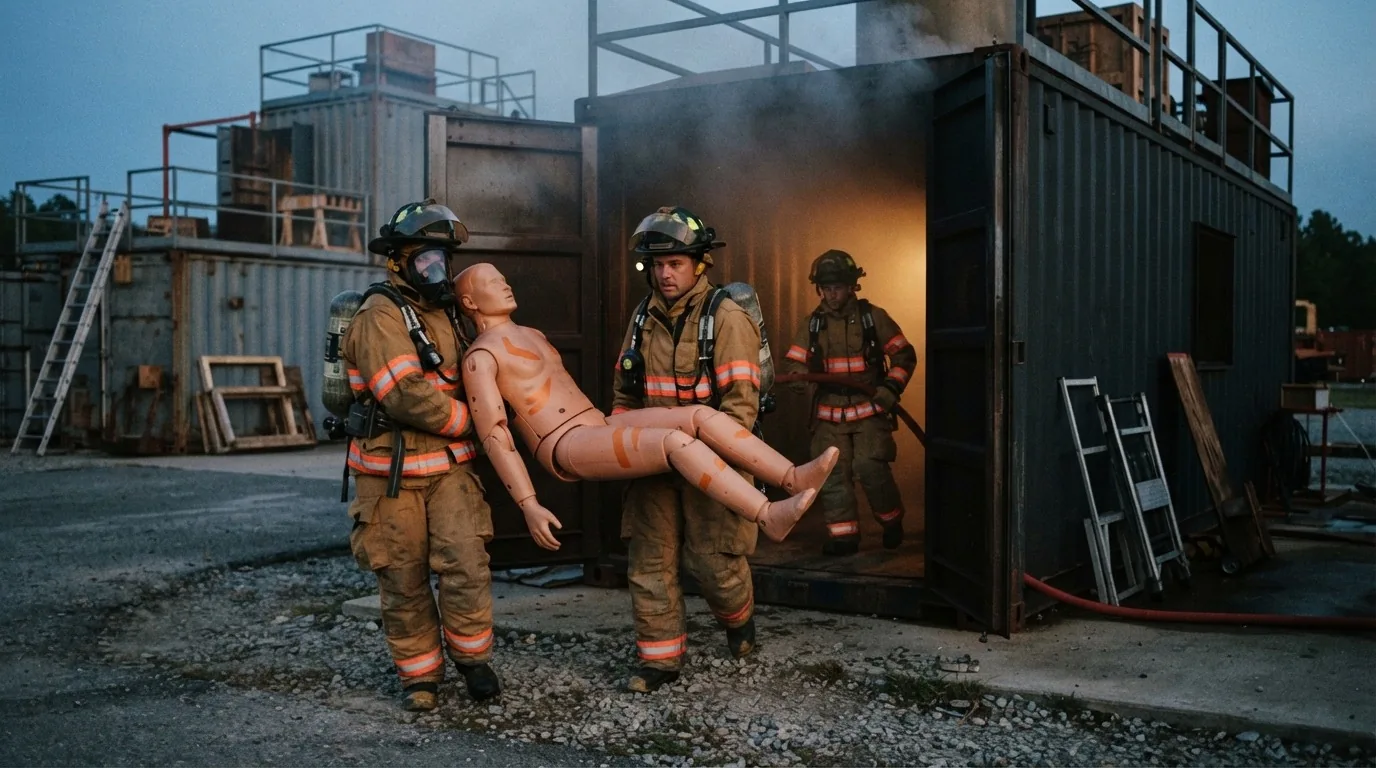
Table A-VI/3 contains four areas of competence, and none of them is about "putting out the fire yourself".
- Control fire-fighting operations aboard ships: fire-fighting procedures at sea and in port, with particular emphasis on organization, tactics and command; the effect of fire-fighting water on ship stability; communication and coordination; ventilation control, including smoke extraction; control of fuel and electrical systems; fire-fighting process hazards such as chemical reactions and boiler uptake fires; fires involving dangerous goods; management and control of injured persons; procedures for coordination with shore-based fire fighters.
- Organize and train fire parties: preparation of contingency plans, composition and allocation of personnel to fire parties, strategies and tactics for control of fires in various parts of the ship.
- Inspect and service fire detection and extinguishing systems and equipment: fire detection systems, fixed fire-extinguishing systems, portable and mobile fire-extinguishing equipment, life-support systems, personal protective equipment and communication equipment; requirements for statutory and classification surveys.
- Investigate and compile reports on incidents involving fire: assessment of the cause of incidents involving fire and of the effectiveness of countermeasures.
Under paragraph 2 of Section A-VI/3, the level of knowledge must be sufficient for the effective control of fire-fighting operations on board ship, and under paragraph 4 the candidate proves competence in accordance with the methods and criteria of columns 3 and 4 of the table — practical exercises and instruction conducted under the most realistic conditions practicable, for example simulated shipboard conditions, and, for control of operations, whenever possible and practicable, in darkness.
Comparing the Two Levels
The table compares both levels on six points. Assessment at the basic level is a practical demonstration with fire extinguishers, breathing apparatus, small and extensive fires, a smoke-filled space and the rescue of a person; assessment at the advanced level is practical exercises and instruction under the most realistic conditions practicable, and for control of operations, where possible, in darkness. The basic-level document is a certificate of proficiency in basic training, where it is not included in the qualification for the certificate of competency; the advanced-level document is a certificate of proficiency titled "Advanced fire fighting", where the training is not included in the qualification for the certificate of competency.
| Question | Basic training (Basic Fire Fighting) | Advanced training (Advanced Fire Fighting) |
|---|---|---|
| Standard | Regulation VI/1; Section A-VI/1, para. 2; Table A-VI/1-2 | Regulation VI/3; Section A-VI/3, paras 1–4; Table A-VI/3 |
| Who needs it | Every seafarer with safety or pollution-prevention duties | Seafarers designated to control fire-fighting operations |
| Role on board | Member of the fire party | Leader of the operation: organization, tactics, command |
| What is taught | Fire prevention, readiness; fire fighting | Control of operations; fire parties; servicing of systems; investigation |
| Assessment and revalidation | Practical demonstration; evidence every five years under Table A-VI/1-2 | Practical exercises; evidence every five years under column 1 of Table A-VI/3 |
| Document | Certificate of proficiency in basic safety training | Certificate "Advanced fire fighting" |
Who Needs Advanced Training
For most officers, advanced training is part of the requirements for the certificate of competency; for ratings, it is needed only upon designation. The Convention does not name positions. It speaks of seafarers "designated to control fire-fighting operations". But the text of the Convention does give two reference points.
Officers
For most officers' certificates of competency, competence under Section A-VI/3 forms part of the qualification requirements directly. A candidate for certification as officer in charge of a navigational watch on ships of 500 gross tonnage or more must meet, among other things, paragraphs 1 to 4 of Section A-VI/3; the same requirement applies to officers in charge of a navigational watch and masters on ships of less than 500 gross tonnage engaged on near-coastal voyages, officers in charge of an engineering watch and electro-technical officers. Guidance B-I/2 explains the consequence: since the certificates of competency under Regulations II/1, II/2, II/3, III/1, III/2, III/3, III/6 and VII/2 already include the requirements for advanced fire fighting, holders of these certificates do not need a separate certificate of proficiency. In Ukraine, to be awarded the rank of officer in charge of a navigational watch, officer in charge of an engineering watch, electro-technical officer, master-engineer or navigator-engineer, the candidate must hold both the certificate of proficiency in basic safety training and the certificate of proficiency in advanced fire fighting, although neither is required within five years from the issue of the maritime education diploma (for a master-engineer — from the issue of the navigator-engineer diploma).
Ratings
For ratings, advanced training is not a general requirement. In Ukraine, the Rules for certification of ratings of seagoing ships' crews link the document directly to designation: the certificate of proficiency in advanced fire fighting is issued to ratings designated to control fire-fighting operations. The qualification requirements for a rating forming part of a navigational watch, a rating forming part of an engineering watch or an electro-technical rating (ship's electrician) in the same Rules list the certificate of proficiency in basic safety training, not in advanced fire fighting. So if you are a rating, you have not been designated to control fire-fighting operations and a company requires Advanced Fire Fighting, this is a requirement of that company or of a specific flag, not an international minimum for everyone.
How Long Advanced Fire Fighting Remains Valid and How to Revalidate
The Code does not set the "validity" of the certificate as a single date. Paragraph 5 of Section A-VI/3 requires seafarers qualified in advanced fire fighting to provide evidence of having maintained the required standard of competence under column 1 of Table A-VI/3 within the previous five years. Paragraph 6 allows Parties to accept onboard training and experience as evidence — but only in the area of control of operations (procedures at sea and in port, communication, ventilation, fuel system, fire-fighting process hazards, fire precautions in the storage and handling of materials, management of injured persons, coordination with shore-based fire fighters). The other three areas of the table — fire parties, servicing of systems, investigation — are not on that list.
The Ukrainian Administration has set the period directly: the certificate of proficiency in advanced fire fighting is valid for five years, and the certificates of competency of masters, deck officers, engineer officers and electro-technical officers and their endorsements certify completion of this training for five years after issue. For documents of other administrations, the wording "the certificate is valid for five years" should be read as follows: after five years you will need evidence of maintained competence, and in what form it is accepted must be checked for the ship you are joining.
What to Check in the Certificate
Paragraph 5 of Guidance B-I/2 of the Code lists the minimum information in a certificate of proficiency, including the title of the certificate and the number of the regulation or section under which it is issued, and gives an example for exactly this case: a certificate issued under paragraph 2 of Regulation VI/3 should be titled "Advanced fire fighting". Check that the document refers to Regulation VI/3 and Section A-VI/3, that the title matches, and that the five-year mark does not fall before the end of your contract. If advanced training is included in your certificate of competency, ask the crewing agency whether the company needs a separate document.
Frequently Asked Questions
Do I have to complete Basic Fire Fighting before Advanced?
The STCW Convention does not make the basic course a condition for admission to the advanced one: Regulation VI/3 and Section A-VI/3 of the Code describe who needs advanced training and what it must contain, but do not require prior completion of training under Regulation VI/1, and Guidance B-VI/3 in Part B of the Code is empty — "No provisions". The basic level is mandatory in its own right: under paragraph 2 of Section A-VI/1, every seafarer with safety or pollution-prevention duties completes basic training, including the fire-fighting element under Table A-VI/1-2, before being assigned to any shipboard duties. So a seafarer who has already worked on board has basic training — not because it is a prerequisite for the course, but because without it they are not allowed to perform duties on board. Ukrainian rules do not set a sequence either: in the Rules for certification of ratings, the certificate of proficiency in advanced fire fighting is issued to those designated to control operations with no mention of prior documents, and the Regulations on Ranks of Ship Officers require both certificates — in basic safety training and in advanced fire fighting — as separate documents for conferring a rank.
Does every seafarer need Advanced Fire Fighting?
No. Regulation VI/3 is addressed to seafarers designated to control fire-fighting operations. The general requirement for everyone whose duties relate to safety is the basic level under Table A-VI/1-2 as part of basic training.
Does advanced training replace basic training?
They are different tables with different areas of competence: A-VI/1-2 is about fighting fires, A-VI/3 about controlling the operations. Candidates for most officers' certificates must meet both. Whether a company accepts a certificate under A-VI/3 as evidence of the basic level is a question for the company and the flag.
Can advanced training be taken remotely?
Column 3 of Table A-VI/3 requires practical exercises and instruction under the most realistic conditions practicable, and for control of operations, where possible, in darkness. Parties may allow seafarers to be trained by distance learning and e-learning in accordance with the standards of Section A-I/6.
Advanced Training in Fire Fighting at AVANT
The AVANT training centre offers an Advanced Fire Fighting course. For conditions, format, duration and the programme, see the course page.
The basic level is the fire-fighting element of Basic Safety Training (BST); what all four elements of basic training cover is described in a separate blog article. If you are assigned to other special duties on board, related certificates of proficiency are those under Regulations VI/2 and VI/4; the centre offers the survival craft and rescue boats course and the medical first aid course. For conditions, format, duration and the programme, see the course pages.
Summary
Basic training teaches you to fight a fire, advanced training teaches you to command. The first is needed by everyone whose duties relate to safety; the second by those designated to control fire-fighting operations, and for officers it is usually part of the certificate of competency. Both are revalidated every five years. If your next position involves commanding a fire party or a company requires a separate certificate, enrol on the Advanced Fire Fighting course at the AVANT training centre.
Specific requirements for a position on board are set by the flag Administration, the company and the ship's documents.
Need to update documents or choose courses for a new contract?
Fill out the seafarer application — our specialists will help determine the required certificate package.
Or contact us directly:
Working hours:
Monday—Thursday: 9:00 AM to 5:00 PM
Friday: 9:00 AM to 4:00 PM
Saturday and Sunday — days off