
Simulator Assessment for Seafarers
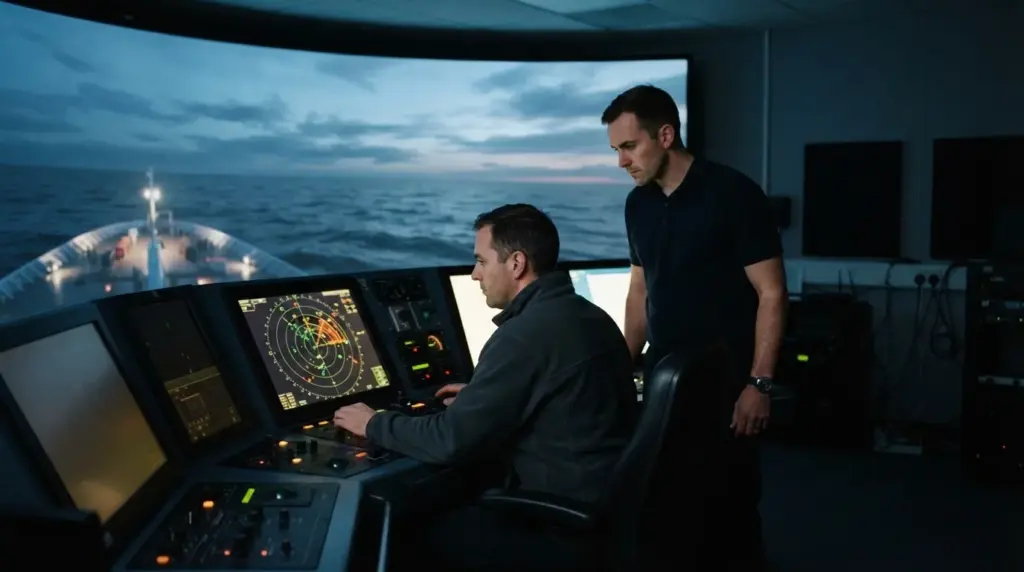
Under the STCW Code, simulator tests for seafarers are not an exam with a pass percentage: the Code requires the assessment criteria to be known to the candidate in advance, and the main one is the ability to perform the task safely and effectively. Behind these words are two different worlds: the classroom simulator at a training centre running Transas systems (part of Wärtsilä since 2018), and the SafeBridge online platform of courses for a specific equipment model (type-specific), owned since 2021 by the Norwegian company Mintra.
Who Transas and SafeBridge Are
Transas is a company founded in 1990, headquartered in the United Kingdom at the time of the deal; Wärtsilä announced the acquisition on 19 March 2018 and completed it on 4 May 2018, calling Transas a global leader in navigation solutions and also a leader in professional training and simulation. The manufacturer describes NTPRO 5000 as a fifth-generation navigational simulation platform; the next-generation navigation simulator in its range is NTPRO 7, which has DNV type approval.
SafeBridge GmbH was founded in Hamburg in 2009; on 18 February 2021 it was acquired by Mintra. At the time of the acquisition its product range included SafeLearn with 15 ECDIS courses, SafeMetrix for psychometric and technical assessments, and myCert for digital certificates. According to Mintra, its ECDIS courses are approved by equipment manufacturers; Wärtsilä is among the nine manufacturers listed.
So Transas is the hardware and software of a simulator in a classroom, and SafeBridge is a browser and an online exam at home. Both can concern the same ECDIS.
What the STCW Code Requires of a Simulator
Regulation I/12 of the Convention requires compliance with the performance standards of Section A-I/12 for all mandatory simulator-based training, for any assessment of competence on a simulator and for any demonstration of continued proficiency. In Ukraine this rule is duplicated: the simulator equipment of seafarer training institutions and the qualifications of their staff must comply with Regulations I/6, I/8, I/12 and Sections A-I/6, A-I/8, A-I/12, and model requirements are approved by the Ministry for Communities, Territories and Infrastructure Development.
A training simulator must suit the training objectives, reproduce the shipboard equipment together with its capabilities, limitations and possible errors, simulate emergency situations and allow the instructor to control and record exercises. An assessment simulator is the same, only with an assessor: to control, monitor and record the candidate's performance.
For radar and ARPA the minimums are specific. A radar simulator must operate in relative and true motion modes, model weather, currents, shadow sectors and spurious echoes, and in real time reproduce at least two own-ship stations and 20 target ships. An ARPA simulator — manual and automatic target acquisition, past position information of targets, exclusion areas, vector display and trial manoeuvres.
Section A-I/12 contains no separate technical requirements for an ECDIS simulator — the general paragraphs 1–2 and the guidance of Part B apply.
How a Training Session Works
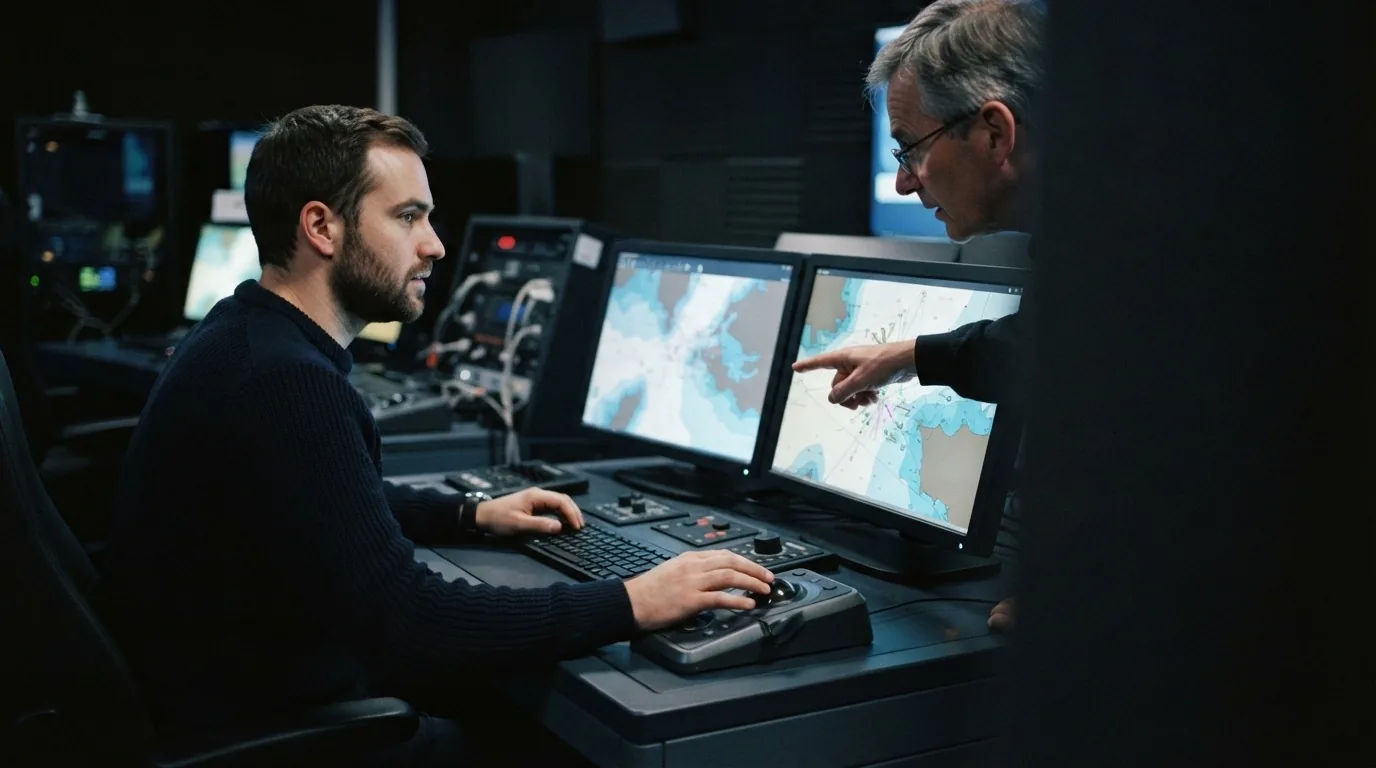
Section A-I/12, paragraph 7, sets out the instructor's duties: to brief trainees in advance on the tasks and objectives of the exercise, to give them time to get familiar with the simulator before training starts, to monitor the exercise and to debrief after it. In practice these are four steps: briefing, familiarization, monitored exercise, debriefing.
On the page of the TCS 5000 crane simulator, the centre describes the same logic in three stages: theoretical preparation, practice on the simulator with standard and emergency scenarios, and analysis and correction with the instructor. In the manufacturer's technological simulators (engine room, liquid cargo) this is the job of the instructor workplace — preparing the exercise, control, monitoring, briefing and debriefing — while the e-Tutor software guides the trainee, assesses performance and records the results automatically.
Who may conduct sessions is also defined. A simulator instructor must have received guidance in instructional techniques involving the use of simulators and have practical experience on the type of simulator used; an assessor — experience of assessment on such a simulator under supervision.

How Assessment Works
Paragraph 8 of Section A-I/12 requires assessors to have clear performance criteria available to the candidates, explicitly established assessment criteria for reliability and uniformity, and maximum objectivity so that subjective judgement is kept to a minimum. The Code sets no pass mark in percent: the criterion is qualitative — safe and effective performance of the task.
One more rule concerns time. Part B recommends that radar plotting and ECDIS exercises be conducted mainly in real time, and for ECDIS accelerated time is allowed only for demonstrations. In other words, a collision-avoidance manoeuvre on a simulator usually takes as long as it would on the bridge.
Where a Simulator Is Mandatory and Where It Is One Option
For an officer in charge of a navigational watch, competence in radar and ARPA is assessed on the basis of "approved training on radar and ARPA simulators plus experience" — the simulator is the only method named here. For ECDIS there is an alternative: approved training ship experience or approved ECDIS simulator training. In basic tanker training, the simulator is one of four acceptable forms alongside seagoing service, a training ship and an approved programme.
The Ukrainian Regulations on the ranks of officers provide for only one case where practice can be directly replaced by a simulator: for advanced training under the IGF Code, two of the three bunkering operations may be replaced by simulator training. The rule is narrow; the Regulations contain no general rule counting simulator days as seagoing service.
Simulators at the AVANT Training Centre
In the "Simulators" section of its website, the centre lists nine items: NTPro 5000, Navi-Sailor 5000 ECDIS, LCHS 5000, TechSim 5000 Crane, TGS 5000 GMDSS, Navi-Radar 4000, ERS 5000 TechSim, a medical training class and a training ship.
The NTPro 5000 navigation simulator models ship handling, mooring, towing and rescue operations; the special exercises listed on the page include mooring to different types of berths, towing, search and rescue operations with helicopters, navigation in ice and fishing operations. Navi-Radar 4000 trains navigators under the STCW Convention — observation, radar plotting, calculation of closest point of approach parameters, display settings — and, according to the centre's page, meets the DNV standard for class A simulators.
LCHS 5000 models the loading, unloading and handling of oil, oil products, chemicals and liquefied gases, as well as ballast, inert gas and firefighting. The training centre runs the course "Tanker Cargo Operations Simulator Training". ERS 5000 reproduces diesel, steam and gas turbine plants and the ship's power supply; according to the centre's page, it is intended for marine engineers and mechanics, Electro-Technical Officers, engine officers and cadets. The centre also runs the course "Engine Room Watchkeeping". For the conditions, format, duration and programme, see the course page.
TGS 5000 reproduces GMDSS equipment — VHF DSC, MF/HF, Inmarsat, EPIRB, SART, NAVTEX — for sea areas A1–A4 and is used in GOC and ROC training. The manufacturer's current version allows switching from network mode to individual mode with Demo, Test and Exam modes. The training ship is no longer a computer: a lifeboat, a smoke-filled firefighting maze, a helicopter cabin, an engine room, liferafts, a motor pump; training under A-VI/1, A-VI/2-1 and A-VI/3.
An Online Course for a Specific ECDIS Model: How SafeBridge Works
Each type-specific ECDIS course on the Mintra platform consists of 10 modules with a recommended completion time of 16 hours; 19 ECDIS models are covered. The course "Wärtsilä NaviSailor 4000 by Transas" is a 960-minute eLearning course approved by the manufacturer and ends with an online exam; generic ECDIS training under IMO Model Course 1.27 is recommended beforehand. The certificate shows the manufacturer's logo and the equipment model.
In Mintra's cloud simulator courses — a separate product — exercises have a time limit with a continuous countdown, and the course ends with a timed exam; all components must be passed — eLearning, simulation and assessment.
Why do companies usually require such a course? Regulation I/14 obliges the company to familiarize seafarers assigned to a ship with their duties and with all ship arrangements, equipment and procedures relevant to them. In its list of ECDIS training requirements, the simulator manufacturer separates generic ECDIS training under A-I/12, B-I/12 and Tables A-II/1–A-II/3 from familiarisation with the equipment of a specific ship (type-specific) under Regulation I/14 and the ISM Code. The first is the field of approved training under the Convention; the second can be covered, among other things, by an online course for a specific model.
Employer Tests and the State Exam
The state assessment of the professional competence of masters and officers in Ukraine is a computer exam in the Crew Evaluation System (CES) 6.0 or its next version; questions are selected automatically from a list, and the exam is passed with 70% or more correct answers. The simulator plays no part in this procedure: the knowledge required for the position is tested. This exam has its own page: the seafarer diploma exam.
Beyond this there is a layer of selection that the Convention does not describe — companies' and crewing agencies' own checks: from psychometric tests to simulator sessions. Among the clients of its simulators the manufacturer names fleet management companies and crewing agencies, and Mintra offers SafeMetrix psychometric assessments for crew recruitment and promotion. The format, duration and pass threshold of such checks are set by the company; there are no official rules for them.
Frequently Asked Questions
What is the pass mark in a simulator exam?
Under the STCW Code, there is none in percent. The assessor announces the criteria in advance and assesses the ability to perform the task safely and effectively.
Can radar and ARPA be passed without a simulator?
No. For an officer in charge of a navigational watch, Table A-II/1 names only one method of assessment — approved training on radar and ARPA simulators plus experience.
Does a simulator replace seagoing service?
Under Regulations No. 1499, only in the narrow case of advanced training under the IGF Code: two of the three bunkering operations may be replaced by a simulator. There is no general rule counting simulator days as service.
How is SafeBridge different from a simulator at a training centre?
SafeBridge is an online course for a specific ECDIS model with an exam in the browser, approved by the equipment manufacturer. A simulator at a centre means a session under an instructor's control following the procedures set by Section A-I/12.
If your next certificate or contract requires simulator training, courses in radar and ARPA, GMDSS, tanker cargo operations and the engine room are in the training centre's course catalogue.
Check the requirements for a specific simulator course with the Shipping Administration of Ukraine and with the employer.
Need to update documents or choose courses for a new contract?
Fill out the seafarer application — our specialists will help determine the required certificate package.
Or contact us directly:
Working hours:
Monday—Thursday: 9:00 AM to 5:00 PM
Friday: 9:00 AM to 4:00 PM
Saturday and Sunday — days off