
First Command as Master
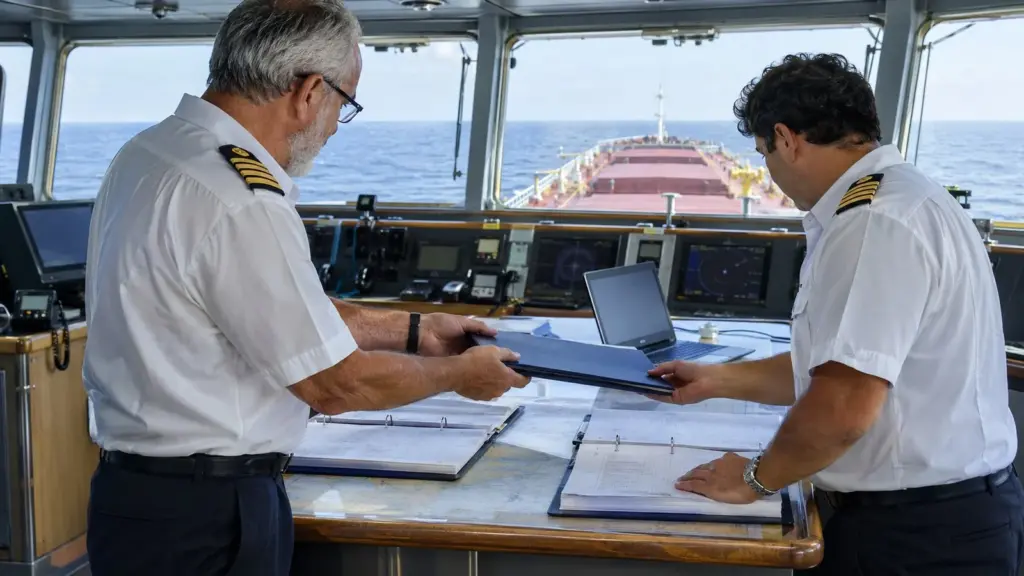
For a first-time master, command starts with the handover. The new master needs to find out what condition the ship is in, which findings are still open after inspections and how the company's procedures are applied on this ship.
What authority the ISM Code gives the master
The route to a master's certificate of competency is covered in How to Become a Ship Captain. The company sets out the master's responsibilities and authority in its safety management system (SMS), as the ISM Code requires.
Section 5 of the ISM Code covers the master's responsibility and authority. Under paragraph 5.1 the company clearly defines and documents the master's responsibility with regard to:
- implementing the company's safety and environmental-protection policy on board;
- motivating the crew to observe that policy;
- issuing appropriate orders and instructions in a clear and simple manner;
- verifying that specified requirements are observed;
- periodically reviewing the SMS and reporting its deficiencies to shore-based management.
Under paragraph 5.2 the SMS operating on board must contain a clear statement emphasizing the master's authority. The company establishes in the SMS that the master has the overriding authority and the responsibility to make decisions with respect to safety and pollution prevention and to request the company's assistance as may be necessary.
Each company words this in its own way, so on a new ship it is worth reading that part of the SMS again.
Taking over command under the ISM Code
The Code has no ready-made checklist for a change of master. Two paragraphs come closest to the handover.
Paragraph 6.1 is addressed to the company: the master must be properly qualified for command, fully conversant with the company's SMS and given the support needed to perform the master's duties safely.
Under paragraph 6.3 the company sets up procedures to familiarise new personnel and personnel transferred to new assignments with their duties. Instructions which are essential to be provided prior to sailing are identified, documented and given.
Ten questions when taking over command
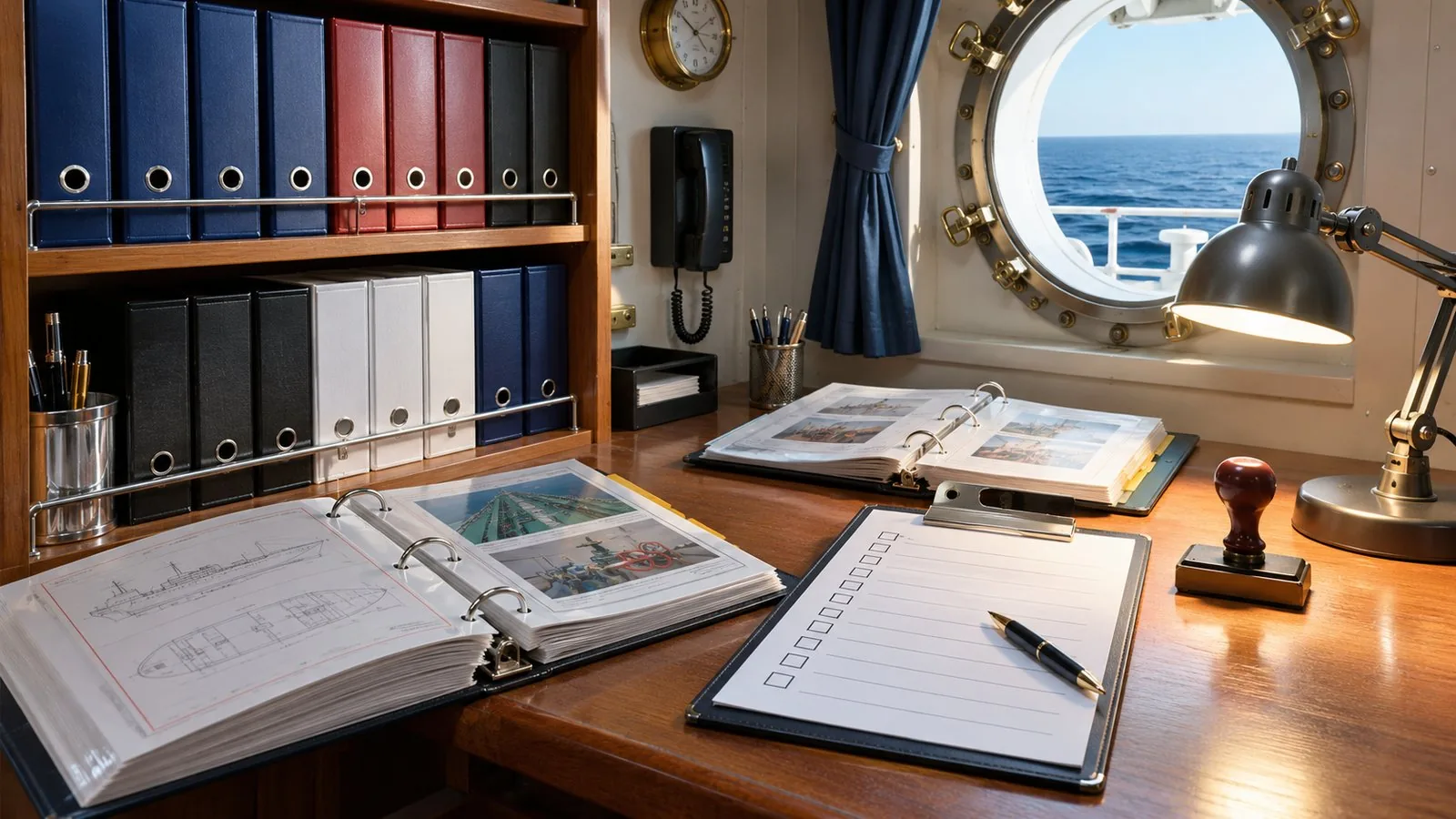 Illustration: safety management system documents in the ship's office
1. Where the current SMS documents are
Start by making sure the company's procedures on board are the current edition. Under paragraph 11.2 the company ensures that valid documents are available at all relevant locations, changes to documents are reviewed and approved by authorised personnel, and obsolete documents are promptly removed. Ask the outgoing master how changes reach the ship and who removes old versions from the bridge and the engine room.
2. What is still open on safety
Get the outgoing master's list of non-conformities, accidents and hazardous situations that are still open: what has been done and who is responsible for the rest. The Code requires every such case to be reported to the company, investigated and analysed, and corrective action to be taken (section 9).
3. What equipment is running with restrictions
The company identifies equipment and technical systems the sudden operational failure of which may result in hazardous situations, and the SMS provides for measures that promote their reliability (paragraph 10.3). During the handover, find out which of them is running with restrictions now and what work on them is still outstanding.
4. What operations are coming up
The new master needs to know which plans for the next voyage, cargo operations and port calls are ready and which are not. For key shipboard operations the company develops procedures, plans and instructions, including checklists as appropriate (section 7).
5. How emergency preparedness is organised
Under section 8 the company identifies potential emergency situations on board, establishes procedures to respond to them and sets up programmes for drills and exercises. During the handover, go through the ship-specific arrangements that the generic documents do not cover.
6. How communication on board works
Ask about two things here: how the bridge and the engine room pass tasks to each other, and what must be reported to the master immediately. Under paragraph 6.7 the company ensures that the ship's personnel are able to communicate effectively in the execution of their duties related to the SMS. Who does what in the crew is explained in Ranks and Positions on a Ship.
7. How to reach the company
The company designates a person or persons ashore having direct access to the highest level of management. The designated person monitors the safety and pollution-prevention aspects of the operation of each ship and ensures that adequate resources and shore-based support are applied (section 4). The new master should write down the designated person's contact details before departure.
8. What is left after inspections
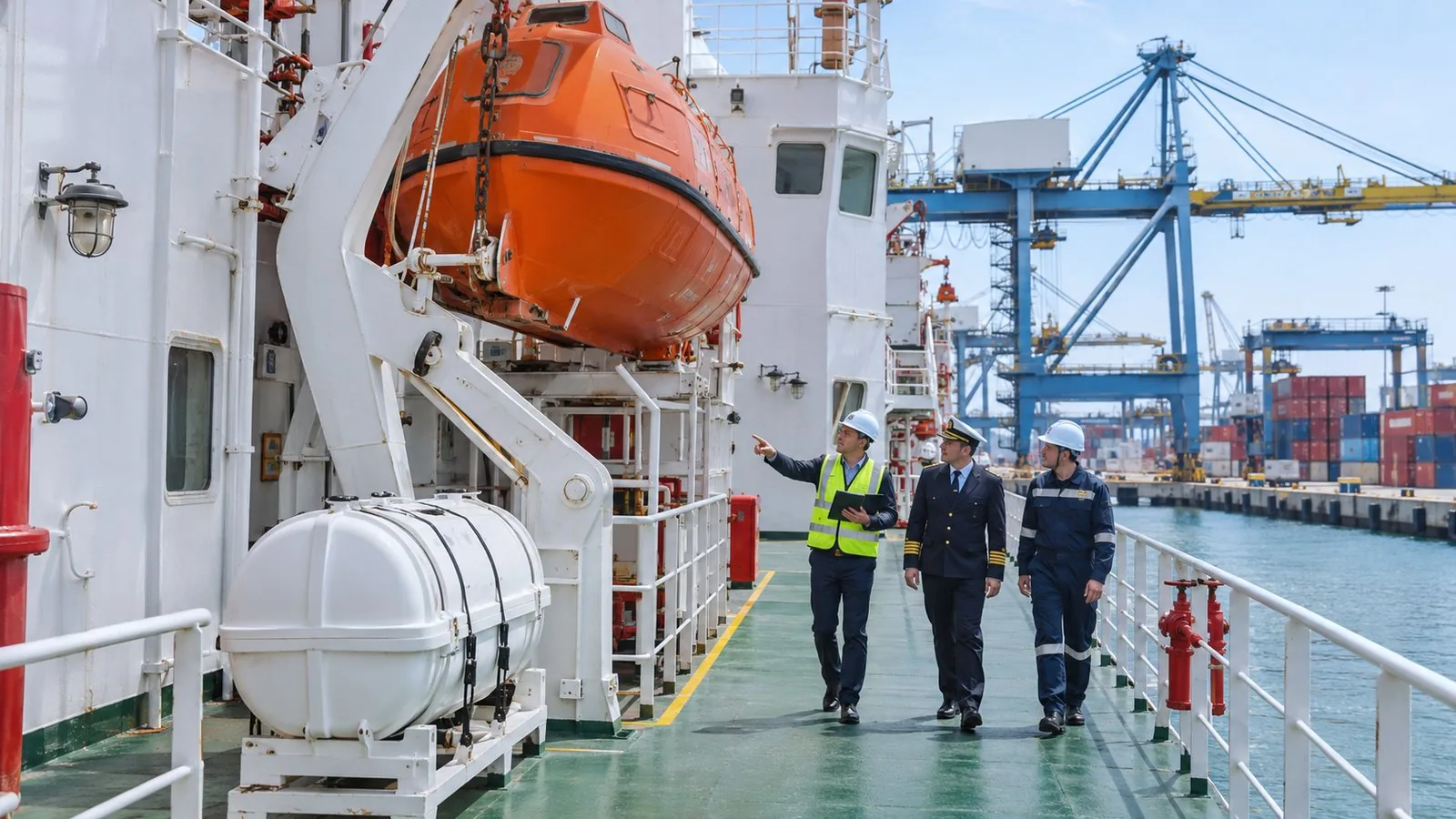 Illustration: inspection of lifesaving equipment on a ship at the berth
The company carries out its own internal safety audits on board and ashore (section 12). Besides that, the ship is inspected by the classification society, port State control (PSC) officers and commercial inspectors such as vetting inspectors. These inspections have different grounds and purposes. It is best to get the list of open findings for each of them from the outgoing master.
In December 2025 the IMO Assembly adopted the recommendatory Procedures for Port State Control, 2025 (resolution A.1206(34)), replacing resolution A.1185(33). Paragraph 2.4.2 lists clear grounds for a more detailed inspection. One of them (subparagraph .6) is information or evidence that the master or crew are not familiar with essential shipboard operations relating to the safety of ships or the prevention of pollution, or that such operations have not been carried out.
9. The master and the pilot on the bridge
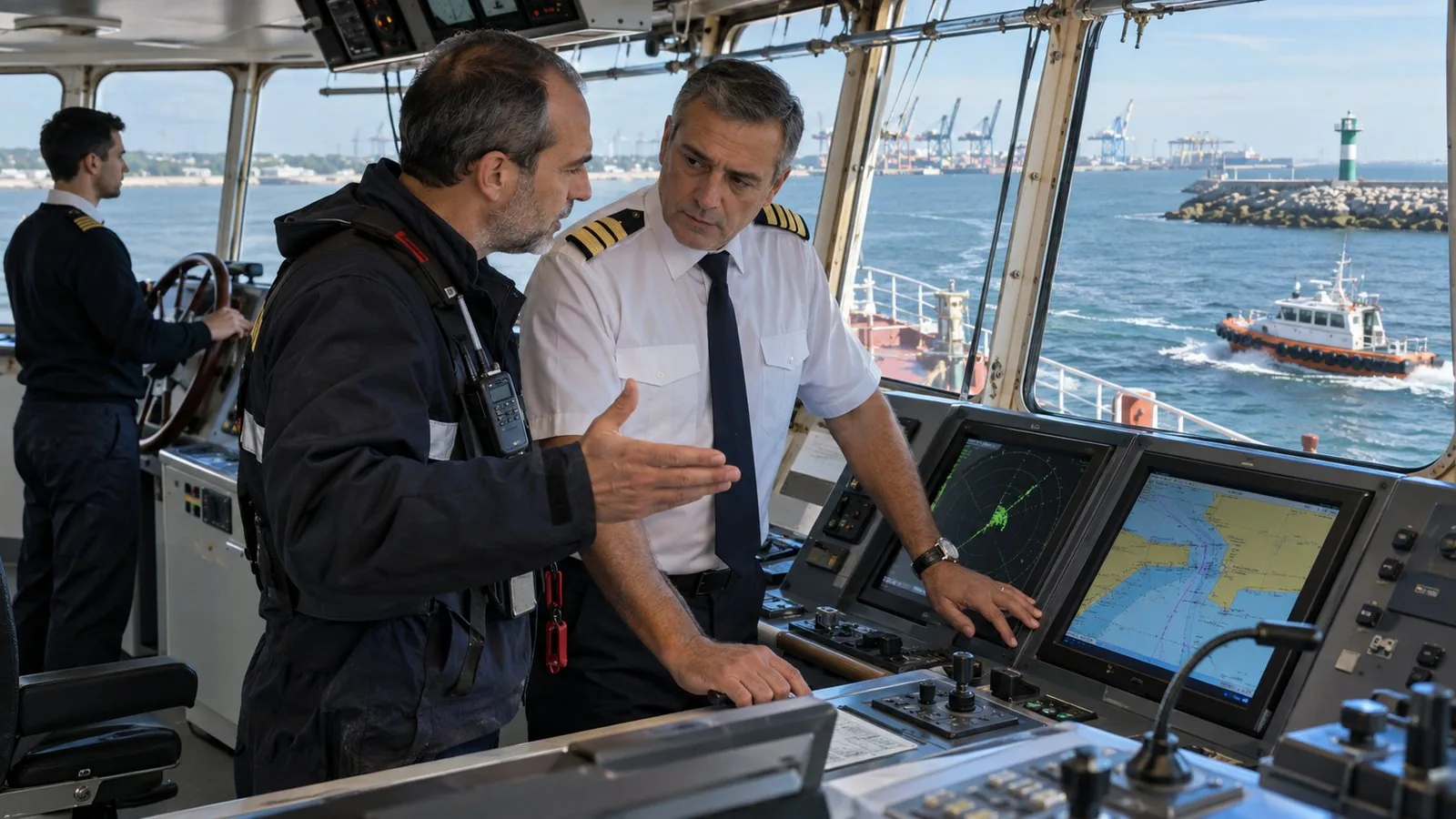 Illustration: the master and the pilot on the bridge entering port
The presence of a pilot does not relieve the master or the officer in charge of the navigational watch of their duties for the safety of the ship. This is set out in the IMO Recommendations on operational procedures for maritime pilots other than deep-sea pilots (resolution A.960(23), annex 2, paragraph 2.1). The master, bridge officers and pilot share responsibility for good communication and for understanding each other's roles (paragraph 2.2).
The master and the pilot exchange information continuously, generally for the whole pilotage (paragraph 5.1). Paragraph 5.4 lists what the exchange should include at least:
- a completed standard Pilot Card, plus data on rate of turn at different speeds, turning circles and stopping distances;
- agreed plans and procedures for the anticipated passage, including contingency plans;
- special conditions expected on the passage: weather, depth of water, tidal currents, marine traffic;
- unusual ship-handling characteristics, machinery or navigation equipment problems, crew limitations;
- berthing arrangements: the number and characteristics of tugs, mooring boats and other external facilities;
- mooring arrangements;
- the language to be used on the bridge and with external parties.
Bridge teamwork with the pilot is practised on the bridge watchkeeping course.
10. What to close before sailing
After walking round the ship, the new master usually still has open questions. It helps to put them into one list: what is closed, what is in progress and who is responsible.
Frequently asked questions
Does the ISM Code have a single checklist for a change of master?
No. The Code requires familiarisation of personnel transferred to new assignments (paragraph 6.3) and control of documents (section 11). Each company describes the master's handover in its own SMS.
What is the master's overriding authority?
The master's right to make the final decision on safety and pollution prevention. It is set out in paragraph 5.2 of the ISM Code together with the responsibility for such decisions and the right to request the company's assistance.
What can give clear grounds for a more detailed PSC inspection?
One of the clear grounds is given in paragraph 2.4.2.6 of the Procedures for Port State Control, 2025 (IMO resolution A.1206(34)): information or evidence that the master or crew are not familiar with essential shipboard operations relating to the safety of ships or the prevention of pollution, or that such operations have not been carried out.
Does the pilot take responsibility away from the master?
No. Under IMO resolution A.960(23) (annex 2, paragraph 2.1) the presence of a pilot does not relieve the master or the officer in charge of the navigational watch of their duties for the safety of the ship.
ISM and leadership courses at the AVANT training centre
The principles of the ISM Code, the role of the SMS, the responsibility and authority of personnel, reporting of non-conformities, accidents and hazardous situations, and corrective action are covered on the ISM Code / Safety Management System course.
Working with people is the subject of the Leadership and Teamwork (Human Element) course: professional communication, resource and workload management, decisions in normal and emergency situations, and resolving conflicts in the crew.
Enrol on a course
To enrol or ask a question, use the form below.
Or contact us directly:
Working hours:
Monday—Thursday: 9:00 AM to 5:00 PM
Friday: 9:00 AM to 4:00 PM
Saturday and Sunday — days off