
Ship's Cook: Duties and Requirements
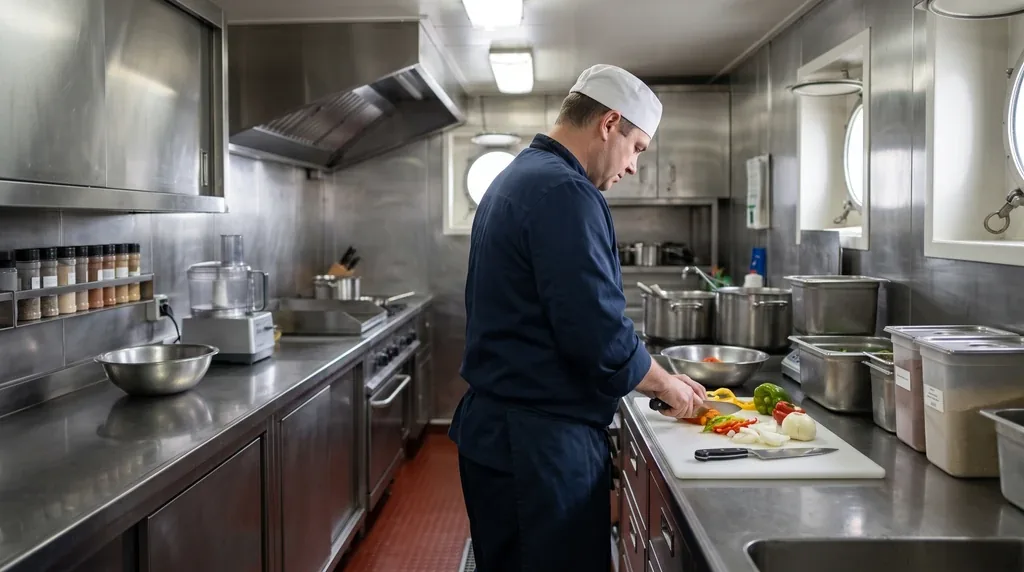
A ship's cook is a crew member whose main duty is to prepare food for the crew, and in Ukraine the right to hold this position is confirmed by a certificate of proficiency issued by the Maritime Administration. To obtain it you need to be 18 years old, be a qualified worker holding a document on vocational education with the working qualification of ship's cook, have three months of sea service or six months of work related to food preparation in the catering industry, and hold two certificates — on basic safety training and on ship security familiarization. Crew food norms are set by the International Labour Organization's Maritime Labour Convention, 2006 (MLC 2006), and under it a cook must be trained and qualified for the position.
Who Is a Ship's Cook
The definition in the Ukrainian Rules for Certification is close to ILO Convention No. 69 of 1946: under the Rules, a ship's cook is a person whose main duty is the preparation of food for the crew of the ship; under the Convention, the person directly responsible for the preparation of food for the crew. In Ukraine's Classifier of Occupations DK 003:2010, "Ship's Cook" carries code 5122 — the same group as the shore-based occupation "Cook," alongside "Cook-Sailor" and "Cook-Steward."
Catering requirements are also taken into account when determining crew size. Among the conventions revised by MLC 2006 are Convention No. 68 on food and catering for crews and Convention No. 69 on the certification of ships' cooks.
What a Cook Does at Sea
The official job description for a Grade IV ship's cook, from the Directory of Qualification Characteristics, Issue 67 "Water Transport," describes the day like this: prepares and serves food to the crew; cooks dishes of medium complexity; takes part in drawing up food orders and checks their quality; takes part in drafting the menu and submits it for approval to the chief mate, or, in their absence, to the master; keeps the galley, storerooms, dishes and refrigerators clean; bakes bread and pastry. Required knowledge covers the particulars of feeding seafarers under different voyage conditions, recipes and cooking technology, storage rules, the basics of balanced nutrition, galley equipment, how to draw up menus and stock reports, and English within the scope of the qualification.
Procurement. How much of a role the cook plays in supply depends on company policy, but monitoring stock, warning the master about food shortages and being able to order supplies are part of the job. The master or a person authorised by the master carries out frequent documented inspections of food and water supplies, storage spaces and galley equipment.
Heavy weather. The cook must know galley safety procedures in bad weather: fiddles (storm bars), holders, clamps and high-sided pans. And people: food is prepared with regard to the religious and cultural particulars of the crew and hygiene requirements.
A full-time dedicated cook is not mandatory under MLC, but the training requirement applies to both full-time and part-time positions.
Grades and Who Else Works in the Galley
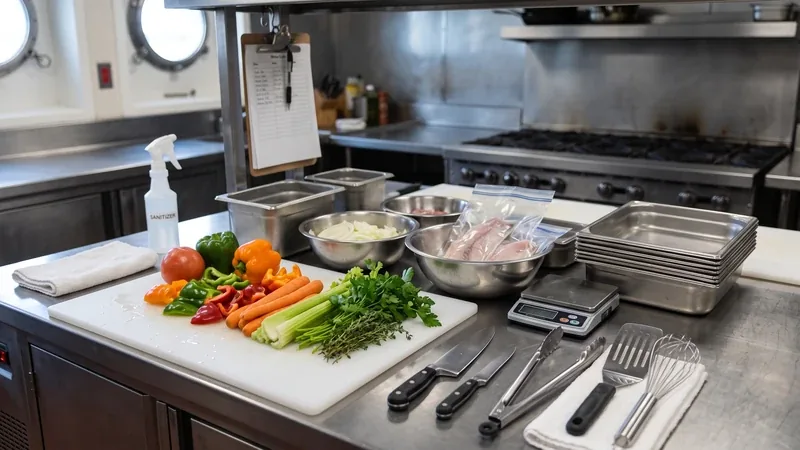
For ship's cooks, Issue 67 sets out three grades. Grade IV: vocational education, advanced training, and at least a year of experience in public catering. Grade V: complex-preparation dishes for tourists on passenger ships, dietary dishes, menus and stock reports; requirements — incomplete higher education and at least one and a half years' experience as a Grade IV ship's cook. Grade VI: especially complex and signature dishes on passenger ships, supervising lower-grade cooks, chef's duties; at least one and a half years' experience as a Grade V ship's cook.
Two others work alongside the cook. The galley hand acts on the cook's instructions, keeps the galley clean, and — if there is only one cook on staff — helps prepare and serve food; there are no experience requirements. The ship's steward serves the officers' mess, distributes food to officers, washes dishes and assists the cook. For someone with no experience yet, galley hand is an accessible entry point into the profession.

Feeding the Crew: What MLC 2006 Guarantees
The standards below come from the International Labour Organization's Maritime Labour Convention, 2006. MLC requirements apply on ships flying the flags of States that have ratified the Convention. A ship in port may be inspected by another state that is a party to MLC, and parties must not give ships flying the flag of a non-party more favourable treatment than ships flying the flag of a party — so port inspections cover such ships too.
The flag state must ensure that ships carry and serve food and drinking water of appropriate quality, nutritional value and quantity, taking into account the crew's cultural and religious backgrounds. Seafarers are provided with food free of charge during their period of engagement — this is stated directly in Regulation 3.2, and the ILO's own FAQ confirms it: a seafarer cannot be required to pay for food on board. Supplies must be suitable in respect of quantity, nutritional value, quality and variety, having regard to the number of seafarers, their religious and cultural requirements, and the duration of the voyage.
The organization and equipment of the catering department must be such as to permit the provision of adequate, varied, balanced and nutritious meals prepared and served in hygienic conditions. All catering staff, including galley hands and stewards, must be properly trained or instructed. Each member state sets minimum standards for the quantity and quality of food and water, and carries out related education work. The details are a matter of national law, within the framework set by Regulation 3.2. "Food and catering" is one of the items a flag state checks before issuing a ship its Maritime Labour Certificate.
Requirements for the Cook Under MLC and Convention No. 69
A cook responsible for food preparation must be trained and qualified for the position. The shipowner must ensure the cook is trained, qualified and found competent under national law. No one under 18 may work as a ship's cook.
MLC itself does not require a certificate as such — that is a matter of national law; the Convention's own requirement is age 18 or over, training, qualification and recognised competence. Training must include an approved course: practical cookery, food and personal hygiene, food storage, stock control, environmental protection and catering safety. A cook's certificate issued before MLC entered into force does not automatically lose validity — it is assessed on its merits.
Exceptions. On ships with a prescribed manning of fewer than ten, the competent authority may not require a fully qualified cook, but whoever does the cooking must be trained in hygiene and food storage. In exceptional circumstances the competent authority may allow a not-fully-qualified cook to work on a specific ship until the next port of call or for no more than one month.
The Convention's non-binding guidance adds: a cook's qualification is awarded on the basis of a minimum period of sea service and a passed examination; the exam and the issuing of certificates are carried out by the competent authority or, under its supervision, an approved cook-training school; states should provide, where appropriate, for the recognition of certificates issued by other states that have ratified MLC or Convention No. 69. The Convention does not name a minimum length of sea service — that is set by the competent authority, and the service can be gained in another position, off the galley.
MLC 2006 revised Convention No. 69, but No. 69 remains in force for states that have ratified it and have not ratified MLC; its logic is the same: no ship shall carry a cook without a certificate of qualification, with an exception for a shortage of qualified cooks. The certificate is issued on reaching the minimum age, having sea service, and passing an examination covering practical food preparation, assessing nutritional value, drawing up menus, and handling and storing food. The examination and issuing of certificates may be carried out by the competent authority or, under its oversight, an approved culinary school.
What Documents Are Needed in Ukraine
The Ukrainian Rules for Certification of Ratings were approved by Order of the Ministry for Communities, Territories and Infrastructure Development No. 784 of 5 September 2023, issued in part on the basis of Convention No. 69. The right to hold the position of ship's cook is confirmed by a certificate of proficiency issued by the Maritime Administration; certificates of proficiency are indefinite and do not require revalidation.
To obtain the ship's cook certificate of proficiency you need: to be 18; to be a qualified worker and hold a document on vocational (vocational-technical) education and the award of the working qualification of ship's cook; at least three months of sea service (as crew on a seagoing merchant ship or a mixed-navigation vessel) or at least six months of work related to food preparation in catering establishments; a certificate of basic safety training; a certificate of ship security familiarization training. The Rules define the document on vocational (vocational-technical) education as a diploma awarding the educational and qualification level of "qualified worker." Sea service is confirmed by the seafarer's record book; catering-industry service by a reference from the employer, an employment record book, or data from the register of insured persons. The application must include a copy of the seafarer's identity document (or another identity document), a 3.5×4.5 cm photo, a copy of the education document (not needed if its details are in the Unified State Electronic Database on Education), proof of service, and copies of the two training certificates. Old certificates of proficiency with the qualification "Ship's Cook" issued before Order No. 784 correspond, in the table of equivalence in the Rules, to the current "ship's cook" certificate.
The two training certificates are general STCW requirements, not a cook-specific programme. All seafarers undergo familiarization and basic safety training or instruction under Section A-VI/1, and where this is not part of a diploma, a certificate of proficiency is issued. Likewise, all seafarers undergo security-related familiarization and security-awareness training under Section A-VI/6. The AVANT training centre runs the Basic Safety Training (BST) course.
A medical certificate is a separate requirement. Every seafarer holding a professional diploma or certificate of proficiency who works on board must have a valid medical certificate. Fitness is determined under the Ministry of Health Rules approved by Order No. 1793; periodic examinations occur every two years unless otherwise stated in the seafarer's medical certificate, and the maximum validity of the certificate for people over 18 is two years; for galley workers the list of medical contraindications contains a separate criterion: chronic ear discharge means permanent unfitness for work in the galley.
Where the certificate is not required: the Rules do not apply to crew members of small, pleasure and river craft, seagoing and mixed-navigation ships under 500 gross tonnage, and fishing vessels under 24 metres in length; including holders of certificates under these Rules in the crews of such vessels is not mandatory.
Galley Hygiene and HACCP
HACCP (hazard analysis and critical control points) is a food-safety control system. The Convention's own requirement is that food is prepared and served in hygienic conditions, and a cook's training course covers food and personal hygiene and food storage. The competent authority is expected to issue guidance on avoiding food wastage and maintaining a proper standard of hygiene.
HACCP itself does not appear in the text of MLC. It is mentioned in the ILO's non-binding Guidelines on the training of ships' cooks (2013) as an internationally recognised system for controlling food hygiene, particularly relevant on passenger ships, and cooks are expected to know its principles. Food standards are set by the flag state; the ILO Guidelines recommend that ships take HACCP principles into account. The AVANT training centre runs a food safety and galley hygiene course.
On passenger ships on international voyages, additional requirements under STCW Regulation V/2 may apply: personnel assigned by the muster list to assist passengers undergo crowd-management training (to be refreshed no less often than every five years), and personnel providing direct service to passengers undergo safety training; whether this applies to a cook depends on the duties assigned to the cook in the muster list.
Where to Train as a Ship's Cook
The AVANT training centre runs the Ship's Cook Training Course (Grade 4). For the conditions, format, duration and programme, see the course page.
Frequently Asked Questions
Does a seafarer pay for food on board?
No. On ships flying the flag of an MLC 2006 member state, food is provided free of charge during the period of engagement, and the ILO FAQ answers the question of whether a seafarer may be charged for food by pointing to this rule.
How long is a ship's cook certificate valid?
In Ukraine, certificates of proficiency for ratings are indefinite and do not require revalidation. A medical certificate is separate, valid for up to two years.
Can shore-based cooking work replace sea service?
Yes: Order No. 784 accepts six months of work related to food preparation in catering establishments in place of the three months of service as crew on a seagoing ship. ILO guidance also allows the minimum sea service to be gained in another position.
Does a cook need a HACCP certificate?
MLC 2006 itself does not require one. Food standards are set by the flag state; the ILO Guidelines recommend that ships take HACCP principles into account.
The Ship's Cook Training Course (Grade 4) is run by the AVANT training centre: enrol on the Ship's Cook Training Course (Grade 4).
The requirements for a cook on a specific ship are set by the flag state and the shipowner.