
Cargo Operations on an Oil Tanker: What STCW Requires and How They Are Practised on a Simulator
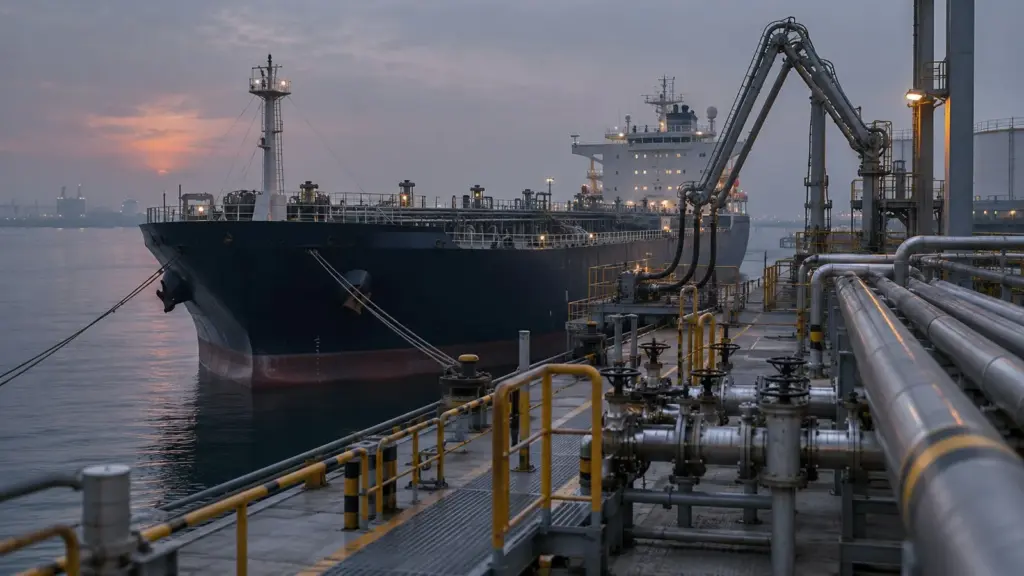
The STCW Code requires anyone responsible for cargo on an oil tanker to be able to safely perform and monitor all cargo operations, from the loading plan to crude oil washing, while keeping stability and hull stresses within safe limits. The Code operates alongside the STCW Convention (the International Convention on Standards of Training, Certification and Watchkeeping for Seafarers): its Part A is mandatory, while Part B contains recommended guidance. Simulator training is one of the approved forms of training: on a cargo simulator, a mistake can be debriefed without putting either the ship or her crew at risk.
What the STCW Code counts as cargo operations
The standard of competence for advanced training in oil tanker cargo operations is set out in Table A-V/1-1-2 of the Code. The table is divided into seven competences, and the first of them, the ability to safely perform and monitor all cargo operations, is the most extensive. It covers oil tanker design and systems, cargo pumps, cargo measurements and calculations, monitoring and gas-detection systems, safety systems and the supervision of personnel.
The operations themselves take up a single knowledge requirement within this competence, with eight items:
- loading and unloading plans;
- ballasting and deballasting;
- tank cleaning;
- inerting;
- gas-freeing;
- ship-to-ship transfers;
- load on top;
- crude oil washing.
The same competence includes the development and application of cargo-related operation plans, procedures and checklists. One of the assessment criteria is that cargo operations are planned, risk is managed, and the work is carried out in accordance with accepted principles and procedures to ensure safety of operations and avoid pollution of the marine environment. Ship-to-ship transfer takes up one item in the standard, while the training centre runs its ship-to-ship operations training for crew members under a programme of its own.
Cargo, ballast and hull strength
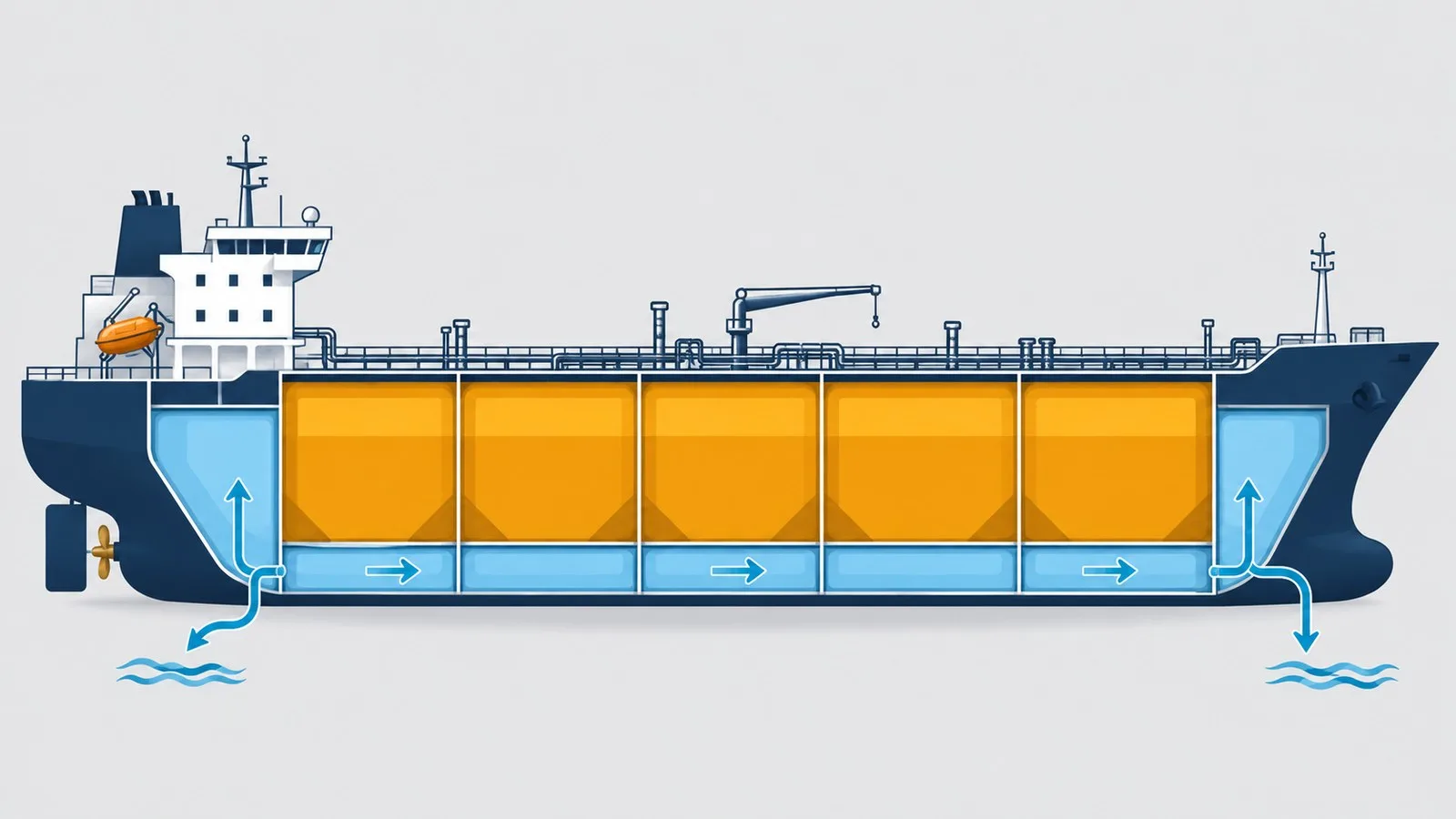 Illustration: cutaway diagram of a tanker's cargo and ballast tanks
As a tanker loads or discharges, her draught, trim, stability and the loads on the hull all change with the cargo. In this first competence, too, the Code requires knowledge of the effect of bulk liquid cargoes on trim, stability and structural integrity. One of the assessment criteria is that proper loading, stowage and unloading of cargoes ensures that stability and stress conditions remain within safe limits at all times.
Ballast belongs to the same calculation. The guidance on cargo handling simulators in paragraph 71 of section B-I/12 of the Code makes this clear: ballasting and deballasting sit in the same item as loading and unloading, together with the calculations for stability, trim, list, longitudinal strength, torsional stress and damage stability. Cargo and ballast are calculated together.
Hazards and safe procedures
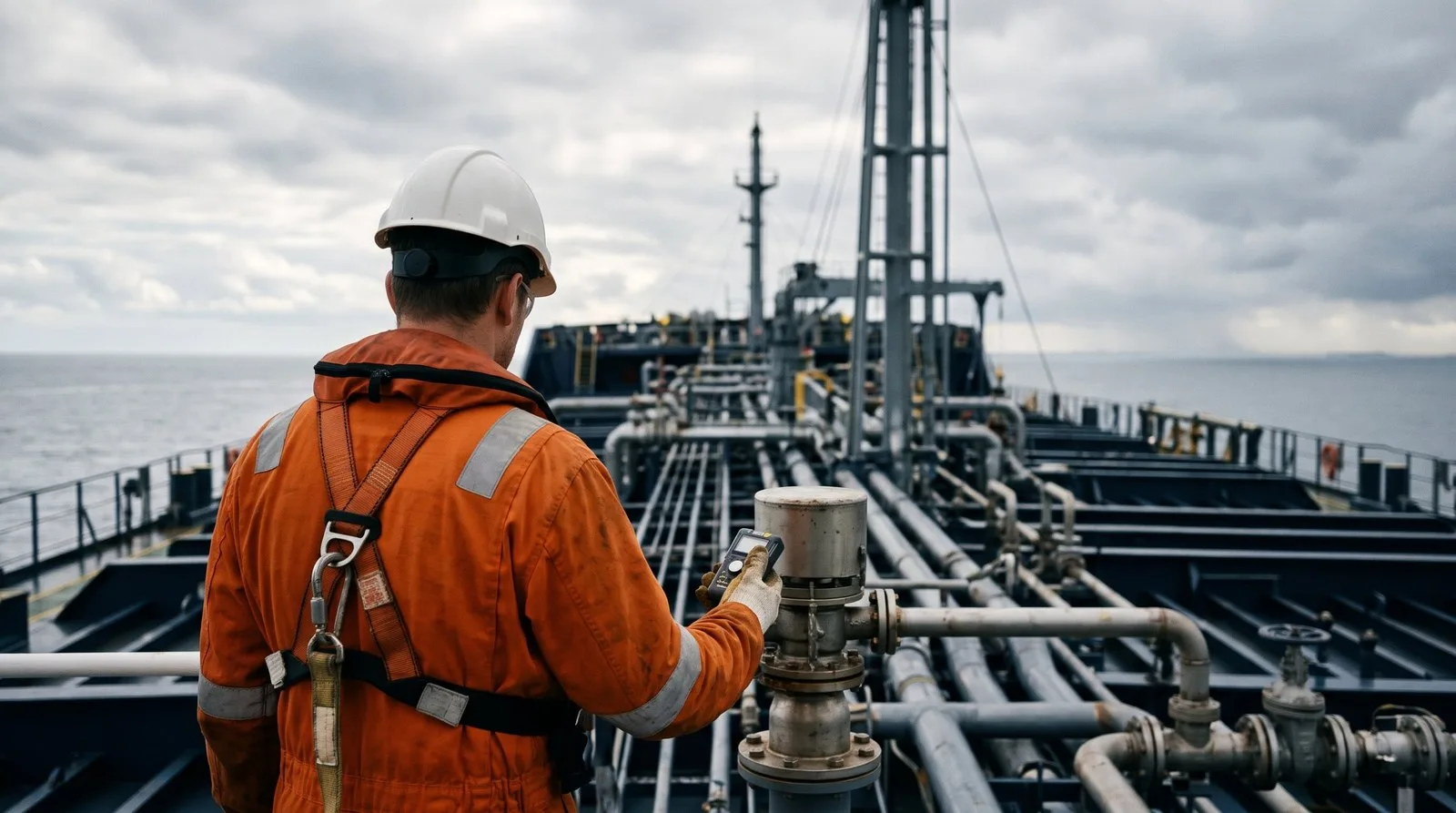 Illustration: officer with a gas detector on a tanker's deck
Hazard prevention has a competence of its own in the standard. It calls for knowledge of the hazards and control measures associated with oil tanker cargo operations: toxicity, flammability and explosion, health hazards, inert gas composition and electrostatic hazards. It also covers the dangers of non-compliance with the relevant rules and regulations. The assessment criterion for this competence is that cargo-related hazards to the vessel and to personnel are correctly identified and proper control measures are taken.
Instruments and alarms, on the other hand, belong to the cargo operations competence. That is where the standard places the ability to calibrate and use monitoring and gas-detection systems, instruments and equipment, together with an understanding of monitoring and safety systems, including the emergency shutdown (ESD). The criteria for that competence include prompt identification and rectification of potential non-compliance with cargo operation procedures, and prompt detection of every alarm, followed by action in accordance with established emergency procedures.
The sixth edition of ISGOTT (International Safety Guide for Oil Tankers and Terminals), the industry reference for tankers and terminals, was published in 2020. It was produced by the International Chamber of Shipping, the Oil Companies International Marine Forum (OCIMF) and the International Association of Ports and Harbors (IAPH). Among the topics it covers are gas monitoring and the toxicity of petroleum products, including that of benzene and hydrogen sulphide.
The competence covering monitoring and control of compliance with legislative requirements calls for knowledge of MARPOL, other IMO instruments, industry guidelines and port regulations. The criterion here is straightforward: the handling of cargoes complies with IMO instruments, established industrial standards and codes of safe working practice.
Emergency response
Table A-V/1-1-2 gives emergencies a competence of their own: ship emergency response plans, cargo operations emergency shutdown, failure of systems or services essential to cargo, firefighting on oil tankers, enclosed space rescue, Material Safety Data Sheets (MSDS), actions following collision, grounding or oil spillage, and medical first aid on board.
Three of the four criteria in this competence are about time. The type and impact of the emergency are identified promptly, the order and timing of reports reflect the urgency of the problem, and evacuation, emergency shutdown and isolation are carried out without delay. A real failure cannot be rehearsed on a loaded ship. On a simulator, the same scenario can be repeated as many times as needed.
What a cargo simulator reproduces
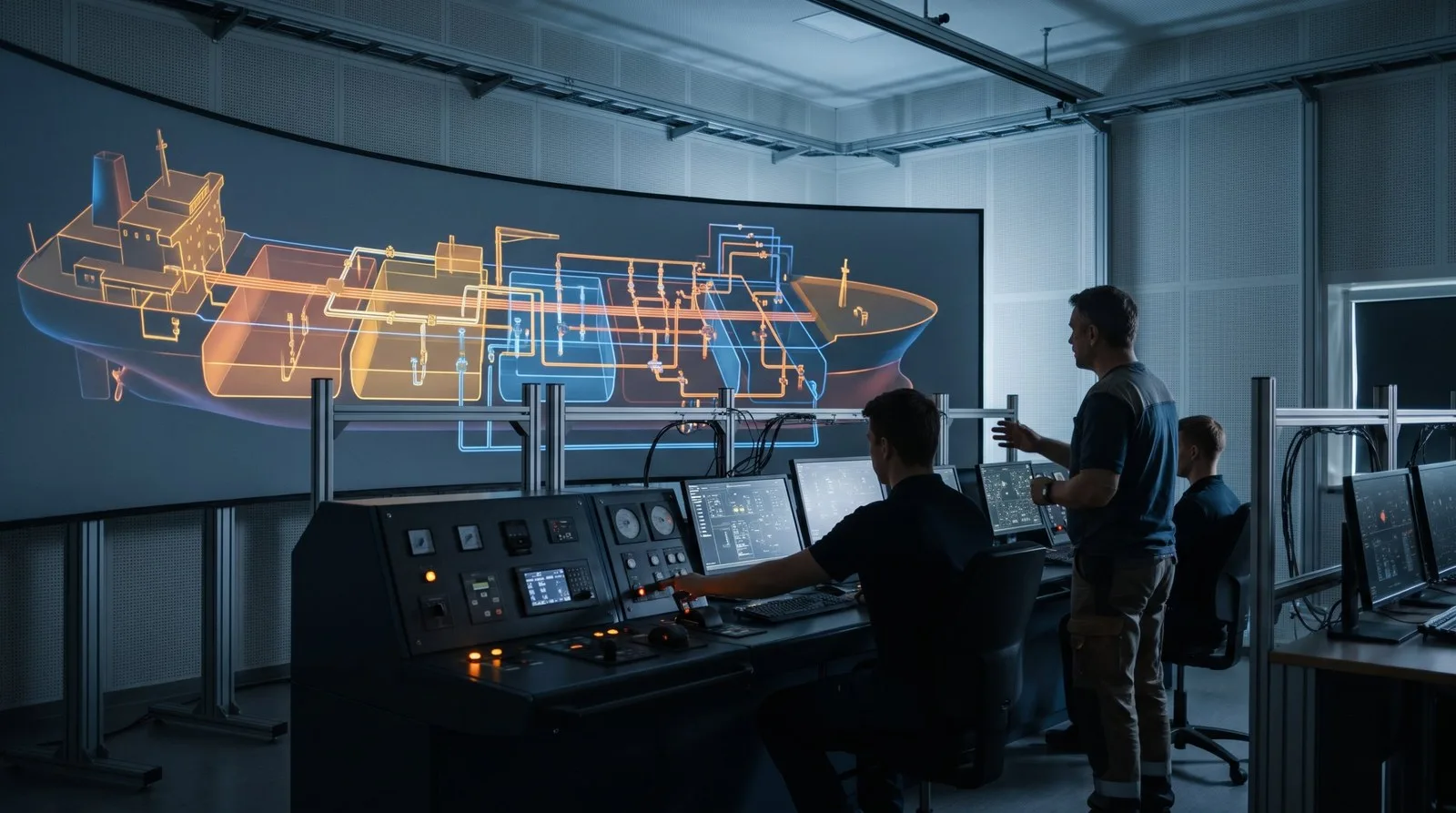 Illustration: cargo control station on a simulator
The guidance for cargo handling simulators is given in paragraph 71 of section B-I/12 of the Code. Under that guidance, a simulator should create an effective operational environment with a cargo control station with instrumentation appropriate to the particular type of cargo system modelled. It should also model loading and unloading together with stability and stress data, and simulate ballasting and deballasting with the appropriate associated calculations.
Table A-V/1-1-2 lists approved simulator training among the ways of demonstrating competence, alongside approved in-service experience, approved training ship experience and an approved training programme. At the AVANT training centre, cargo and ballast operations are practised on the Liquid Cargo Handling Simulator LCHS 5000.
What the course covers
The Liquid Cargo and Ballast Handling on Oil Tankers course is designed for ship's officers and personnel responsible for these operations. The theory can be taken in person or by distance learning, while the practical part on the LCHS 5000 simulator takes place in person at the training centre. During the training, participants work through the full cycle: cargo tank preparation, loading, the loaded voyage, discharge, ballast operations, inert gas system operation and tank cleaning.
The programme lists the following skills: operating cargo pumps, pipelines and valves; monitoring cargo level, temperature and pressure; the inert gas system; monitoring, alarm and emergency shutdown systems; controlling stability, trim and hull stress; and responding to equipment failures and emergencies.
Knowledge is assessed by a final test, with a demonstration of practical skills where required; on passing, a certificate of completion is issued. The programme follows regulation V/1-1 of the STCW Convention, the guidance in paragraph 71 of section B-I/12 of the Code and IMO Model Course 2.06 (Oil Tanker Cargo and Ballast Handling Simulator).
Who needs the course
Under paragraph 3 of regulation V/1-1 of the STCW Convention, a certificate of proficiency in advanced training for oil tanker cargo operations is required for:
- masters;
- chief engineer officers;
- chief mates;
- second engineer officers;
- any person with immediate responsibility for loading, discharging, care in transit, handling of cargo, tank cleaning or other cargo-related operations on oil tankers.
Section B-V/1 of the Code explains who has immediate responsibility: a person in a decision-making capacity with respect to these operations.
The conditions for the certificate are set out in paragraph 4 of regulation V/1-1. A candidate must:
- meet the requirements for certification in basic training for oil and chemical tanker cargo operations;
- while qualified for certification in basic training for oil and chemical tanker cargo operations, have at least three months of approved seagoing service on oil tankers, or at least one month of approved onboard training on oil tankers in a supernumerary capacity, which includes at least three loading and three unloading operations and is documented in an approved training record book;
- complete approved advanced training and meet the standard of competence specified in section A-V/1-1, paragraph 2 of the Code.
Under paragraph 7 of regulation V/1-1, the Administration (a government authority) ensures that the certificate of proficiency is issued. The certificate of completion is a training centre document. Validity periods and the list of documents required to work on tankers are covered in the article Tanker Endorsement Requirements.
Frequently asked questions
Can the course be taken by distance learning?
The theory, yes: it is delivered in person or by distance learning. The practical part on the LCHS 5000 simulator takes place in person at the training centre.
How do I obtain the certificate of proficiency in advanced training?
The Administration ensures that it is issued once all the conditions of regulation V/1-1, paragraph 4 of the STCW Convention are met: basic training, seagoing service or onboard training on an oil tanker, and approved advanced training. After the course, the training centre issues a certificate of completion.
What document is issued after the course?
A certificate of completion of the Liquid Cargo and Ballast Handling on Oil Tankers course. It is issued after the final test, with a demonstration of practical skills where required.
Find the right courses for your contract
Fill in the form below and a training centre manager will get in touch.
Or contact us directly:
Working hours:
Monday—Thursday: 9:00 AM to 5:00 PM
Friday: 9:00 AM to 4:00 PM
Saturday and Sunday — days off
Sources
- International Convention on Standards of Training, Certification and Watchkeeping for Seafarers, 1978, and the STCW Code (IMO): regulation V/1-1, Table A-V/1-1-2, sections B-I/12 and B-V/1.
- Official Ukrainian text of the STCW Convention and Code (Verkhovna Rada of Ukraine).
- International Safety Guide for Oil Tankers and Terminals (ISGOTT), Sixth Edition (ICS).