
Standard Marine Communication Phrases (SMCP)
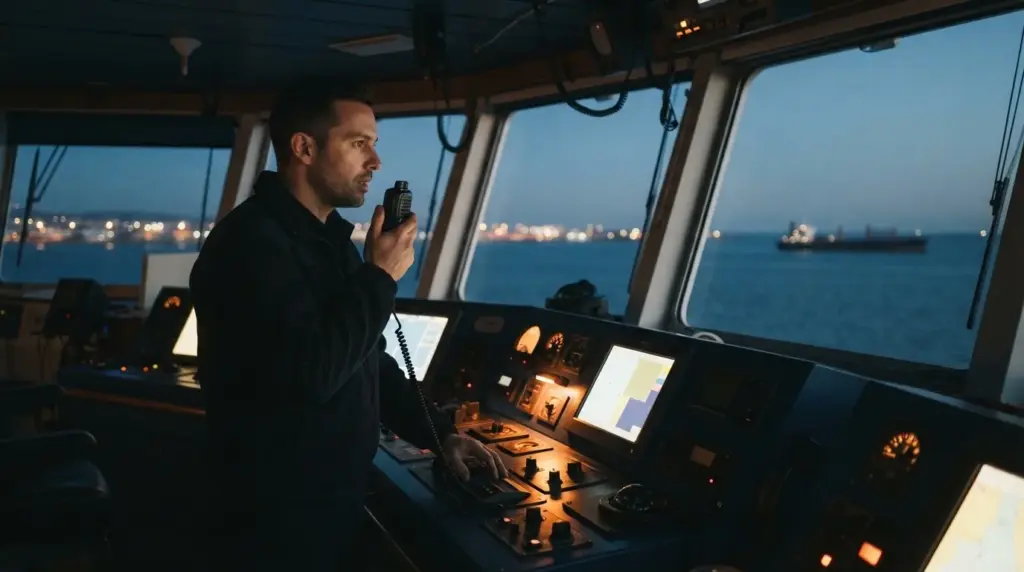
Working maritime English is the IMO Standard Marine Communication Phrases (SMCP), adopted by Resolution A.918(22) in 2001: helm and engine orders, radio exchanges, reports of a fire or a person overboard, requests for medical assistance, passenger briefings and the watch handover. Each phrase corresponds to one event, contracted forms are avoided, and helm and engine orders are always repeated — this, not the size of the vocabulary, is what sets maritime English apart from everyday English. Learn it through the situations that come with your own position: the helmsman — helm orders, the deck officer — radio exchanges and emergency reports, the steward — passenger briefings.
Where English Is Written into International Rules
SOLAS Regulation V/14.4 requires that on ships to which Chapter I of the Convention applies, English be used on the bridge as the working language for bridge-to-bridge and bridge-to-shore safety communications and for communications on board between the pilot and bridge watchkeeping personnel, unless those directly involved in the communication speak a common language other than English. It is this rule that the IMO cites in the preamble to Resolution A.918(22), and Part A of the SMCP, according to the resolution, is to be regarded as an integral part of any training programme preparing for the STCW requirements.
The STCW Code mentions English directly in the requirements for five groups:
- officers in charge of a navigational watch — Table A-II/1: use of the SMCP and of English in written and oral form for charts, nautical publications, meteorological information and communication with other ships, coast stations and VTS centres;
- engineers and electro-technical officers — Tables A-III/1 and A-III/6: adequate knowledge of English to use technical publications and to perform duties;
- GMDSS radio operators — Table A-IV/2: the SMCP and English in written and oral form for communicating information relevant to safety of life at sea;
- deck ratings — Table A-II/4: carrying out helm orders, including orders given in English;
- personnel providing direct service to passengers — Section A-V/2, para. 2: safety training must take into account that the ability to use an elementary English vocabulary for basic instructions can provide a means of communicating with a passenger.
For the rest of the crew, the conventions require the ability to communicate on elementary safety matters and to understand safety information symbols, signs and alarm signals, without naming the language; in practice, this is the working language of the ship. A level on a scale such as B1/B2, a specific test and a pass mark are not set by the conventions — they are requirements of the shipowner and the crewing company. Why a seafarer needs English at all and what STCW and employers require of it is described in the article "Importance of English Language for Seafarers".
How SMCP Phrases Are Built
The IMO Standard Marine Communication Phrases were adopted by the IMO Assembly on 29 November 2001 by Resolution A.918(22) to standardize the language used in communication for navigation at sea, in port approaches, waterways and harbours, and on board ships with multilingual crews. Part A of the collection covers external communication (distress, urgency, safety, vessel traffic services, pilotage) plus standard helm and engine orders; Part B covers on-board communication: watch handover, safety on board, cargo operations, passenger care.
The phrases are built on a few principles, and these are worth learning first:
- one phrase for one event; synonyms are avoided;
- contracted forms (isn't, can't) are avoided;
- yes/no questions are answered with a full phrase, not a single word;
- in time-critical situations, "block language" is used — articles and the verb is/are are used sparingly or omitted;
- letters are spelt with the Alfa, Bravo, Charlie… Zulu table, numbers are spoken digit by digit, and a radio message may begin with one of eight message markers — as provided for in the General section of the resolution.
A separate SMCP section is devoted to "ambiguous words". Instead of "May I enter the fairway?" you should say "QUESTION. Do I have permission to enter the fairway?"; instead of "You should anchor in anchorage B 3" — "ADVICE. Anchor in anchorage B 3"; instead of "You could be running into danger" — "WARNING. You are running into danger". As the document itself notes, misunderstandings caused by such words have already led to accidents.
The IMO's own caveat: the SMCP is not a complete Maritime English syllabus — vocabulary, grammar and conversation skills must go wider, and the phrases should be learnt selectively, according to the user's needs, in practice in a maritime setting.
Eight Situations and Where to Find Them in the Resolution
| Situation on board | IMO SMCP section (A.918(22)) |
|---|---|
| Helm orders | A2/1 |
| Engine orders | A2/2 |
| VHF radio communication | General, paras 1–10 |
| Fire on board | B2/3.2 |
| Man overboard | B2/6.2 |
| Request for medical assistance | A1/1.3 |
| Watch handover | B1/1 |
| Passenger briefing | B4/1.2 |
In the resolution, a slash separates alternatives ("Port / starboard five" means port five or starboard five), three dots mark the place for a name, number or position, and brackets mark an optional part.
Helm Orders
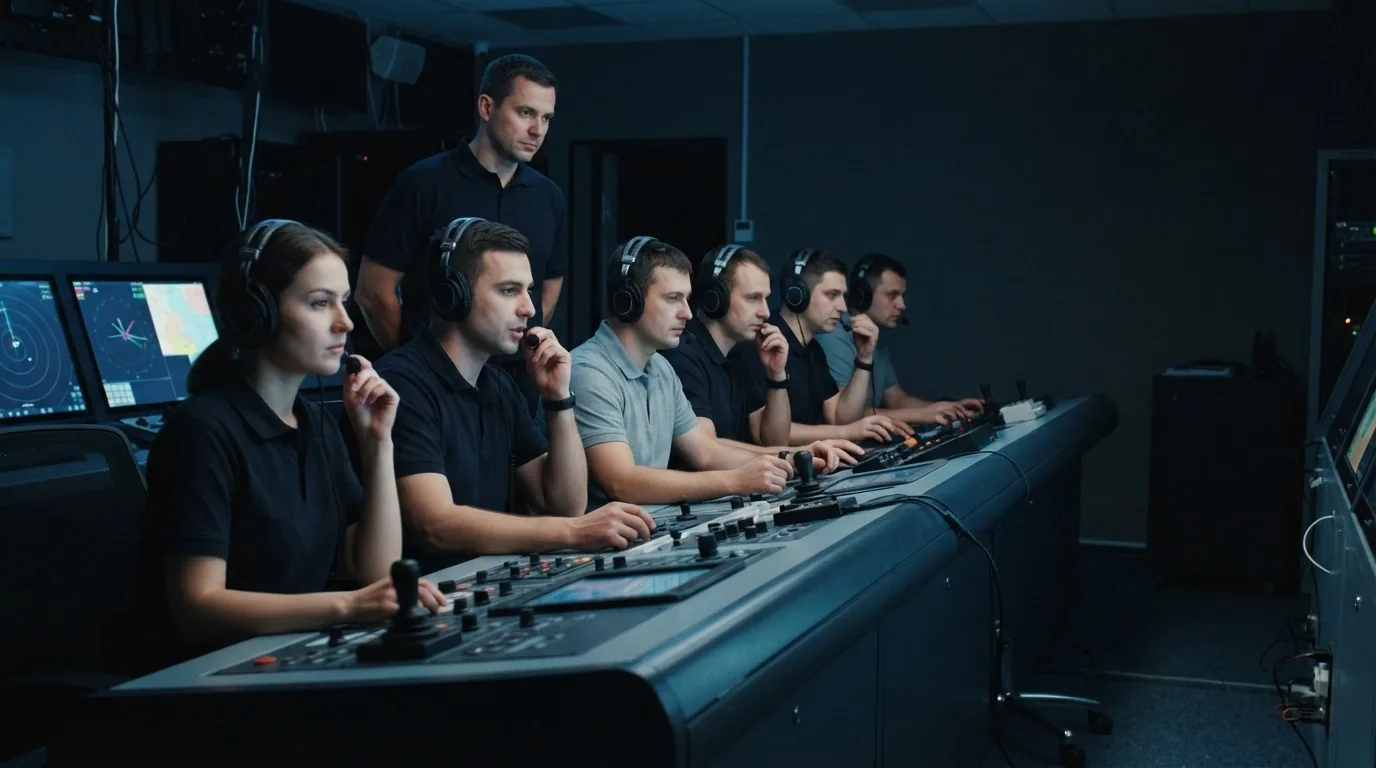
These orders are heard on the bridge whenever the ship is steered by hand: entering port, under pilotage, in narrow waters. Section A2/1, Standard Wheel Orders, requires the helmsman to repeat each order and the officer of the watch to make sure it is carried out correctly and immediately; an order remains in force until countermanded.
- Midships (rudder amidships, in the centreline).
- Port / starboard five (5° of rudder).
- Port / starboard ten.
- Port / starboard fifteen.
- Port / starboard twenty.
- Hard-a-port / starboard (rudder fully to one side).
- Meet her (check the swing of the bow).
- Steady (reduce the swing as quickly as possible).
- Ease to five / ten (likewise: fifteen, twenty).
- Steady as she goes (the helmsman repeats the order and calls out the compass heading, and once the ship is on it reports "Steady on …").
- Keep the buoy / mark / beacon / ... on port side / starboard side.
- Report if she does not answer the wheel.
- Finished with wheel, no more steering.
- Port, steer one eight two (course figures are spoken digit by digit; the helmsman repeats and, once on the course, reports: "Steady on one eight two").
- What is your heading? — My heading is ... degrees (a check question to the helmsman when there is doubt about their attention).
How to practise: in pairs, one gives the order, the other repeats it word for word and reports that it has been carried out — fifteen orders in a row without pausing to translate in your head. Separately, practise saying courses digit by digit and rudder angles as a whole number: "one eight two", but "fifteen".
Engine Orders
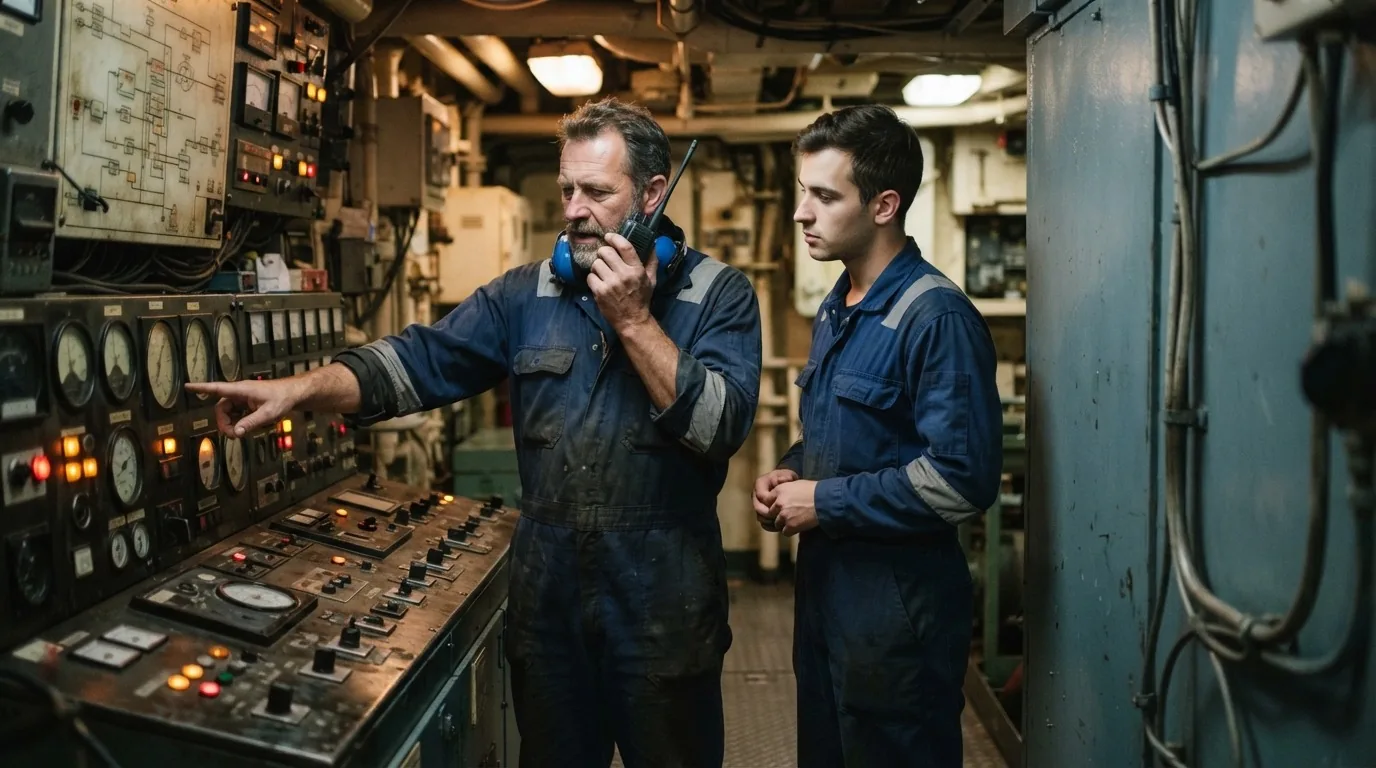
Engine orders are given from the bridge during manoeuvring; Section A2/2 requires the person operating the engine telegraph to repeat each order and the officer of the watch to monitor its execution.
- Full ahead / astern.
- Half ahead / astern.
- Slow ahead / astern.
- Dead slow ahead / astern.
- Stop (port / starboard) engines.
- Emergency full ahead / astern.
- Stand by engine (the engine room is ready to manoeuvre, the bridge is ready to give orders).
- Finished with engines – no more manoeuvring.
- Full ahead both (on twin-screw ships, "both" is added to orders for both shafts).
- Bow thruster full / half to port / starboard.
- Stern thruster full / half to port / starboard.
- Bow / stern thruster stop.
How to practise: the same "order — repeat — report" exercise, but with the telegraph or a diagram of it in front of you: your hand moves the handle to the right position as you repeat the phrase.
VHF Radio Communication
These expressions from the General section are heard in any radio exchange: with a coast station, a vessel traffic service, another ship. They set the frame into which all the other phrases of the collection fit, and a message may begin with one of eight markers: INSTRUCTION, ADVICE, WARNING, INFORMATION, QUESTION, ANSWER, REQUEST, INTENTION.
- ADVICE. Do not overtake the vessel North of you. — I will not overtake the vessel North of me. (Instructions and advice are answered with a full phrase using "I will" / "I will not".)
- Stand by (information will follow within the stated time).
- No information.
- MAYDAY — distress signal; PAN PAN — urgency signal; SECURITE — safety signal.
- How do you read (me)?
- I read you ... (followed by a readability rating on a scale from bad/one to excellent/five: for example, "I read you good/four").
- Stand by on VHF Channel ... / frequency ...
- Standing by on VHF Channel ... / frequency ...
- Advise (you) change to VHF Channel ... / frequency ...
- Changing to VHF Channel ... / frequency ...
- My present speed is 14 knots - mistake. Correction, my present speed is 12, one-two, knots (after "Mistake" and "Correction", the corrected part is repeated).
- Do not overtake - repeat - do not overtake (an important part of the message is secured with the word "repeat").
- Say again (please) (when the message was not heard).
- One-five-zero — 150; Two decimal five — 2.5 (numbers are spoken digit by digit).
How to practise: record yourself — ten messages a day, each with a marker at the start and numbers spoken digit by digit; when you listen back, note where may, might, should, could slipped in, and rephrase with a marker.
Fire on Board
The reports and orders of Section B2/3.2 are heard from the first second of the alarm: the fire report, questions from the bridge, orders to the fire party. Every answer is a full phrase, not a single "yes".
- Fire on board!
- Smoke / fumes / fire / explosion in engine room (engine room can be replaced by a hold, the superstructure or any other space).
- Report injured persons / casualties.
- No person injured.
- What is on fire?
- Is smoke toxic?
- Is fire under control?
- Yes, fire (in ... ) under control.
- No, fire (in ... ) not under control (yet).
- Fire spreading (to ... ).
- Pressure on fire mains!
- Shut down main engine(s) / auxiliary engine(s) / ... and report.
- Close all openings (in ... / in all rooms) and report.
- Stand by fire fighting team / rescue team / first aid team / support team and report.
- Start fire fighting.
How to practise: a role-play following the structure of the section — one person reports ("Fire on board! Smoke in engine room"), the other asks questions from the bridge ("Is fire under control?"), the first answers with a full phrase. Then swap roles. The goal is for an order to end with "and report", and a report with the status: under control or not.
Man Overboard
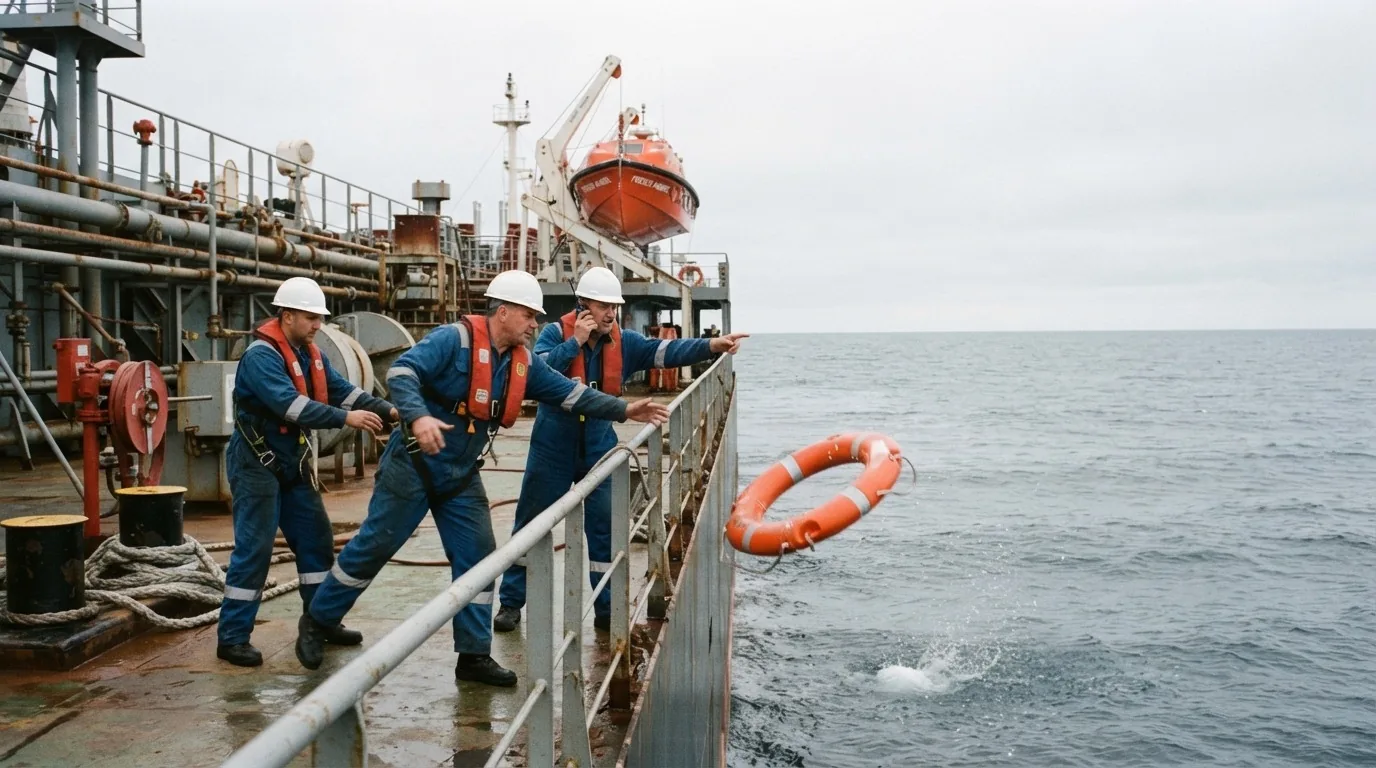
Section B2/6.2 is the sequence of actions from the shout to the launching of the boat. Time here is measured in seconds, so the phrases are short, and most of them are orders.
- Man overboard (on port side / starboard side / astern)!
- Drop lifebuoy(s).
- Sound "man overboard" alarm.
- Hoist flag signal "Oscar".
- Hard-a-port / hard-a-starboard the wheel.
- Is person in water / lifebuoy located?
- Report direction and distance of person in water / lifebuoy.
- Maintain visual contact to person in water / lifebuoy.
- Stop engine(s).
- Return manoeuvre! Port / starboard, steer ... degrees.
- Have man overboard stations / lookouts at ... manned and report.
- Stand by boat / motor lifeboat no. ... for letting go and report.
- Let go rescue boat / motor lifeboat.
How to practise: say the whole sequence aloud in thirty seconds — from "Man overboard on port side!" to "Let go rescue boat" — then repeat it during a drill on board.
Request for Medical Assistance
Section A1/1.3 is external communication: the ship asks a coast station or another ship for assistance. This is the case where a full phrase matters more than speed: what is sent — a boat, a helicopter or radio advice — depends on precision.
- I require / MV ... requires medical assistance.
- What kind of assistance is required?
- I require / MV ... requires boat for hospital transfer.
- radio medical advice (an alternative answer after "I require / MV ... requires").
- I / MV ... will send boat.
- arrange for radio medical advice on VHF Channel ... / frequency ... (an alternative after "I / MV ... will").
- Boat / helicopter ETA at ... UTC / within ... hours.
- Do you have doctor on board?
- Yes, I have doctor on board.
- No, I have no doctor on board.
- Can you make rendezvous in position ... ?
- Transfer person(s) to my vessel / to MV ... by boat / helicopter.
How to practise: make a card for your ship — name, call sign, position, course and speed, number of persons on board, whether there is a doctor — and practise the request following this section, spelling the name with the Alfa–Zulu table and giving the position digit by digit.

Watch Handover
Section B1/1 is what the officer of the watch reports to the officer relieving them: position, movement, draft, the situation around the ship. Who hands over the watch to whom and how the crew is organised is described in the article "Ranks and Positions on a Ship: Who Does What in the Crew".
- The present position is latitude ..., longitude ...
- The next waypoint / reporting point is ...
- ETA at ... is ... UTC.
- We are passing / we passed buoy ...(charted name) on port side / starboard side.
- True course / gyro compass course / magnetic compass course is ... degrees.
- Speed over ground / through water is ... knots.
- Draft forward / aft is ... metres.
- Underkeel clearance is ... metres.
- A vessel is crossing from starboard side.
- The vessel will pass ... kilometres / nautical miles ahead / astern.
- There is heavy traffic / ... in the area.
How to practise: fill in a daily watch handover template in English following the structure of the section — position, movement, draft, situation — even if the watch is not yet yours: during sea practice or at home with a chart.
Phrases for Passenger Ship Personnel
Section A-V/2, para. 2, of the STCW Code requires that safety training for personnel providing direct service to passengers take into account that the ability to use an elementary English vocabulary for basic instructions can provide a means of communicating with a passenger in need of assistance. For stewards, waiters and cooks this means, above all, the specific phrases of the safety briefing and announcements — Section B4/1.2 of the collection.
- International regulations require all passengers to be assembled in a drill which has to take place within 24 hours of departure.
- A drill will be held to familiarize passengers with their assembly stations, with their life-saving equipment and with emergency procedures.
- All passengers must attend this drill.
- In case of emergency seven short blasts and one prolonged blast will be given with the ship's whistle and the alarm system.
- Remain calm when you hear the general emergency alarm.
- Always act immediately if you detect fire or smell fumes or smoke.
- Always inform a member of the crew if you detect fire or smell fumes or smoke.
- Never smoke in bed.
- Attention please! Attention please! This is your captain with an important announcement.
- There is no immediate danger to our passengers or the ship and there is no reason to be alarmed.
- For safety reasons we request all passengers to go to their assembly stations on deck and wait there for further instructions.
- Please follow the instructions given by the officers and crew.
Since 1 January 2015, SOLAS Regulation III/19 has required that on voyages where passengers are scheduled to be on board for more than 24 hours, musters of newly embarked passengers take place prior to or immediately upon departure.
How to practise: read the announcements aloud as a PA announcement — slowly, without contractions, with pauses between sentences; record yourself and listen to check whether a passenger for whom English is not a native language would understand you.
The AVANT training centre offers the "Maritime English for Passenger Ship Crew Course". For conditions, format, duration and the programme, see the course page.
How to Learn Maritime English: a Practical Approach
Start from situations, not from a dictionary. The helmsman needs helm orders, the motorman engine orders, the deck officer radio exchanges, the watch and all the emergency sections, the steward passenger briefings; the IMO advises the same — learn the phrases selectively, according to the user's specific needs.
Next comes the "repeat — confirm" habit. In the SMCP, every helm and engine order is repeated and the officer of the watch makes sure it has been carried out, and this habit is the shortest way to make a phrase work under pressure: you do not translate in your head, you reproduce a pattern. Structure comes with it: a marker at the start ("QUESTION.", "INSTRUCTION."), a full answer instead of a single "yes", no contractions, an order ending with "and report", as in Sections B2/3.2 and B2/6.2 of the resolution.
Letters and numbers — every day. The ship's name, call sign, position and course are spelt with the Alfa–Zulu table and spoken digit by digit; five minutes of spelling a day is an exercise you can do without a partner.
And keep the original to hand: Resolution A.918(22) is openly published on the IMO website. It does not replace general English — working with charts and nautical publications, meteorological information and safety messages is named directly in Table A-II/1 and requires a wider vocabulary than the standard phrases.
Frequently Asked Questions
Do I need to learn the SMCP by heart?
Not the whole collection. The IMO itself advises learning the phrases selectively — the ones that relate to your duties — and in practice, not as a list. Part A of the collection, according to the resolution, is to be regarded as an integral part of training programmes under STCW.
What to Check Before the Contract
- What is the working language of the ship, and is it English?
- Which SMCP sections relate to my position, and can I reproduce these phrases without preparation?
- Do I repeat an order before carrying it out, and do I end a report with the status ("under control" / "not under control")?
- Do I spell the ship's name, call sign and position with the Alfa–Zulu table and digit by digit?
- Do I understand emergency announcements and alarm signals in English — seven short blasts and one prolonged?
Maritime English is tested by the situation — a helm order, an alarm, a pilot on the bridge, a passenger who needs help — and it is trained the way it sounds on board: from the situation, with the standard phrase, with the mandatory repeat. If your next position requires STCW training, courses by subject are collected in the centre's course catalogue.
The level of English required for a specific position is set by the flag State, the shipowner and the crewing company.
Need to update documents or choose courses for a new contract?
Fill out the seafarer application — our specialists will help determine the required certificate package.
Or contact us directly:
Working hours:
Monday—Thursday: 9:00 AM to 5:00 PM
Friday: 9:00 AM to 4:00 PM
Saturday and Sunday — days off