
If a Seafarer Falls Sick on Board
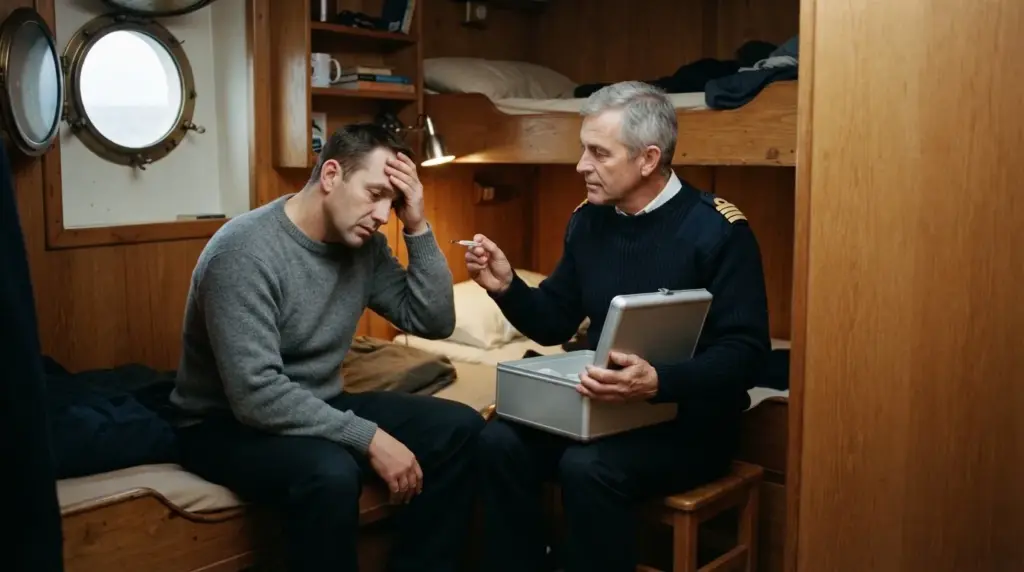
A seafarer who falls sick during a voyage has the right to prompt medical care on board — in principle free of charge — and to access to medical facilities ashore, while treatment, medicines and board and lodging until recovery, or until the sickness or incapacity has been declared of a permanent character, are paid for by the shipowner: this is what the Maritime Labour Convention, 2006 (MLC 2006) requires on ships flying the flags of member States. The flag State may limit this obligation to a period of not less than 16 weeks. Exactly how long this obligation lasts, how wages are calculated during sickness and in what form financial security exists are determined by the law of the flag, the seafarers' employment agreement (SEA) and the collective agreement.
When These Rules Apply
The standards of MLC 2006 are minimum standards: ratification of the Convention does not affect any law, custom or agreement that ensures more favourable conditions for seafarers. The Convention does not apply to ships engaged in fishing or in similar pursuits, ships of traditional build (such as dhows and junks), or warships and naval auxiliaries. For ships of less than 200 gross tonnage not engaged in international voyages, the competent authority of the flag State may, after consulting shipowners' and seafarers' organizations, determine that it would not be reasonable or practicable to apply certain details of the Code of the Convention — but only to the extent that the matter is dealt with differently by national laws, collective agreements or other measures.
MLC requirements apply on ships flying the flags of States that have ratified the Convention. If a ship flies the flag of a State that has not ratified the Convention, the terms of medical care and the shipowner's obligations are determined by the applicable law, your contract and the circumstances of the port call. Member States are obliged not to give such ships more favourable treatment than ships flying the flag of a member State, but this provision is addressed to member States and does not automatically give the seafarer all the rights under the Convention.
What to Do if You Fall Ill on Board
Under the Convention, a doctor is mandatory on ships carrying 100 or more persons and ordinarily engaged on international voyages of more than three days; which other ships must carry a doctor is determined by the law of the flag. Other merchant ships may have no doctor. On a ship without a doctor, the Convention requires at least one seafarer in charge of medical care or competent to provide medical first aid; the ship carries a medicine chest, medical equipment and a medical guide, and medical advice by radio or satellite communication is available 24 hours a day.
If immediate medical care is needed, the State in whose territory the ship is must ensure prompt disembarkation of the seafarer and access to medical facilities ashore. A standard medical report form is provided for the exchange of information between ship and shore; its contents are confidential and used only to facilitate treatment.
If your right to medical care is violated, the ship must have an on-board complaint procedure, and victimization for filing a complaint is prohibited. This does not take away the right to turn to a trade union or a lawyer.

What Care the Ship Must Provide
Seafarers on ships covered by the Convention must be covered by measures for the protection of their health and have access to prompt and adequate medical care while working on board — in principle free of charge. Under Standard A4.1, the national laws of the flag State must require that:
- every ship carries a medicine chest, medical equipment and a medical guide, the contents of which are prescribed and regularly inspected by the competent authority;
- ships carrying 100 or more persons and ordinarily engaged on international voyages of more than three days carry a qualified medical doctor;
- ships without a doctor have at least one seafarer in charge of medical care and administering medicine, or at least one seafarer competent to provide medical first aid — with training meeting the requirements of the STCW Convention;
- medical advice by radio or satellite communication, including specialist advice, is available 24 hours a day and free of charge to all ships irrespective of the flag.
The level of care must be as comparable as possible to that generally available to workers ashore — including access to medicines, equipment, diagnosis and treatment. In ports of call, a seafarer has the right to visit a qualified medical doctor or dentist without delay — where practicable. Care on board or when landed in a foreign port is free of charge to the extent consistent with the national law and practice of the flag State. It is precisely because of the qualifications "in principle" and "to the extent consistent with national law" that the scope of free care may differ from flag to flag.
What the Shipowner Is Liable For
Medical care is one thing, money is another. The financial side of sickness during a voyage is governed by Regulation 4.2 "Shipowners' liability"; its purpose is to protect seafarers from the financial consequences of sickness, injury or death occurring in connection with their employment. Under Standard A4.2.1, the shipowner is liable to:
- bear the costs for sickness and injury occurring between the date of commencing duty and the date on which the seafarer is deemed duly repatriated, or arising from their employment between those dates;
- defray the expense of medical care, including medical treatment and the supply of the necessary medicines and therapeutic appliances, and board and lodging away from home — until the sick or injured seafarer has recovered, or until the sickness or incapacity has been declared of a permanent character;
- where the sickness or injury results in incapacity for work — pay full wages as long as the seafarer remains on board or until repatriated; after repatriation or landing — wages in whole or in part, as prescribed by national laws or collective agreements, until recovery or until the seafarer becomes entitled to cash benefits under the legislation of the State concerned;
- pay the cost of burial expenses if death occurs on board or ashore during the period of engagement.
The limits: the flag State may limit the liability for medical care, board and lodging to a period of not less than 16 weeks from the day of the injury or the commencement of the sickness, and limit the payment of wages to a seafarer no longer on board to the same period. Sixteen weeks is the minimum, which the flag may increase but not reduce.
In addition, national law may exclude the shipowner from liability in respect of injury incurred otherwise than in the service of the ship, injury or sickness due to the wilful misconduct of the seafarer, or sickness intentionally concealed when the engagement is entered into, and to the extent that the costs of treatment, board and lodging or burial are assumed by the State.
When Financial Security Applies
MLC 2006 provides for two different financial security systems, and they are often confused.
Security in the event of abandonment is triggered if the shipowner fails to cover the cost of repatriation, has left the seafarer without the necessary maintenance and support, or has otherwise unilaterally severed their ties with the seafarer, including failure to pay contractual wages for a period of at least two months. "Necessary maintenance and support" includes necessary medical care.
Security for shipowners' liability assures compensation in the event of the death or long-term disability of a seafarer due to an occupational injury, illness or hazard, as set out in national law, the seafarers' employment agreement or the collective agreement. Contractual compensation under the SEA must be paid in full and without delay, without pressure to accept a smaller amount, and, where the assessment is difficult, with interim payments.
What this means in practice:
- An ordinary sickness during a voyage is the direct liability of the shipowner; compensation for long-term disability is a different mechanism. But if the shipowner has left a sick seafarer without maintenance and medical care, it may already be a case of abandonment.
- Financial security is not necessarily insurance. Both for abandonment and for death or long-term disability it may be social security, insurance, a fund or another similar arrangement; the form is determined by the flag State after consultation with shipowners' and seafarers' organizations.
- The proof must be on board. A certificate or other documentary evidence of financial security, in English or accompanied by an English translation, must be carried on board, with a copy posted in a conspicuous place available to the seafarers; for the security in the event of abandonment, this applies to ships that are subject to certification under the Convention.

What to Check Before Signing the Contract
The SEA must contain the particulars required by the Convention — including the health and social security protection benefits to be provided by the shipowner and the seafarer's entitlement to repatriation. The precise entitlements to repatriation — the destination, the mode of transport, which costs are covered — are governed by the applicable national law, the collective agreement or other measures. These are questions worth putting to the crewing agency or the shipowner before signing.
| Situation | What MLC provides | What the seafarer should clarify |
|---|---|---|
| Sickness and treatment during the voyage | Care on board and in port, in principle free of charge; the shipowner pays for treatment and board and lodging until recovery; if incapacitated, wages — in full on board, after landing in whole or in part; limit — not less than 16 weeks. | The ship's flag and whether that State has ratified MLC 2006; whether the ship is covered by the Convention by type and size; what the SEA and the collective agreement say about payment for treatment and wages during sickness and after landing. |
| Need to be landed ashore | The State in whose territory the ship is ensures disembarkation and access to medical facilities; a doctor or dentist in port; free of charge within the limits of the flag's law. | Whether there is a doctor on board, and if not, who is responsible for medical care; who decides on repatriation due to sickness and who pays for it. |
| Repatriation, abandonment and financial security | Two separate systems: in the event of abandonment and for the shipowner's liability for death or long-term disability; certificates on board, in English or accompanied by an English translation. | Who is the provider of the security under Regulations 4.2 and 2.5 and whether the certificate can be seen; what form it takes (insurance, a fund, another arrangement); what the contract provides for in case of long-term disability. |
For your part, check that your medical certificate is valid for the whole contract period; that the medical questionnaire has been filled in completely and honestly; that you have with you your own medicines that you take regularly, and that the person responsible for medical care knows about them. What exactly to take on a voyage — from documents to a personal first aid kit — is described in the checklist of items and documents for the voyage.
Training in Medical Care
There is a single rule here: a ship without a doctor must have either at least one seafarer in charge of medical care and administering medicine as part of their regular duties, or at least one seafarer competent to provide medical first aid. A seafarer in charge of medical care must have completed training in medical care meeting the requirements of the STCW Convention; a seafarer providing first aid, training in medical first aid. Which level of training is needed on a particular ship is determined by the law of the flag State, taking into account the duration, nature and conditions of the voyage and the number of seafarers on board.
MLC 2006 does not link this requirement to positions and does not set a "basic level" for the whole crew. Who is designated as responsible and what training they need is decided by the law of the flag, the shipowner and the requirements of the position, so the question "do I need this training" is worth asking the crewing agency before the contract.
How medical care differs from medical first aid and which three levels of medical training STCW sets is explained in the article Medical First Aid on Board Ship. For those who need the training, the AVANT training centre offers a "Medical Care Onboard Ship" course. For conditions, format, duration and the programme, see the course page.
Frequently Asked Questions
Is the shipowner obliged to pay for my treatment?
On ships flying the flags of member States — yes, until recovery or until the incapacity has been declared permanent, with the right of the flag State to limit this to a period of not less than 16 weeks.
Will I be paid wages while I am sick?
Yes, if the sickness has resulted in incapacity for work: in full while you are on board or until repatriation, then in whole or in part under the law of the flag or the collective agreement; the limit of liability is the same, not less than 16 weeks.
Can payment for treatment be refused?
The Convention allows the flag State to exclude the shipowner from liability if the injury was incurred otherwise than in the service of the ship, in the case of the seafarer's wilful misconduct, if the sickness was intentionally concealed when entering into the contract, and to the extent that the costs are assumed by the State. Whether these exceptions have been introduced depends on the law of the flag.
Is the shipowner's financial security the same as insurance?
Not necessarily: social security, insurance, a fund or another arrangement — the form is chosen by the flag State; the certificate or other documentary evidence of financial security must be on board, with a copy posted in a conspicuous place available to the seafarers.
If your position or the shipowner's requirements call for such training, take training in medical care on board ship at the AVANT training centre.
In a disputed situation, contact a maritime lawyer or a seafarers' trade union.
Need to update documents or choose courses for a new contract?
Fill out the seafarer application — our specialists will help determine the required certificate package.
Or contact us directly:
Working hours:
Monday—Thursday: 9:00 AM to 5:00 PM
Friday: 9:00 AM to 4:00 PM
Saturday and Sunday — days off